
In the wake of systemic crises and national tragedies, the public has become weary of the ubiquitous cycle of “thoughts and prayers.”
To the marginalized communities often hit hardest by policy failures and systemic oppression, this rhetoric frequently rings as performative allyship – nothing but a metaphysical shield used by political and religious leaders to deflect from the urgent need for real, material change.
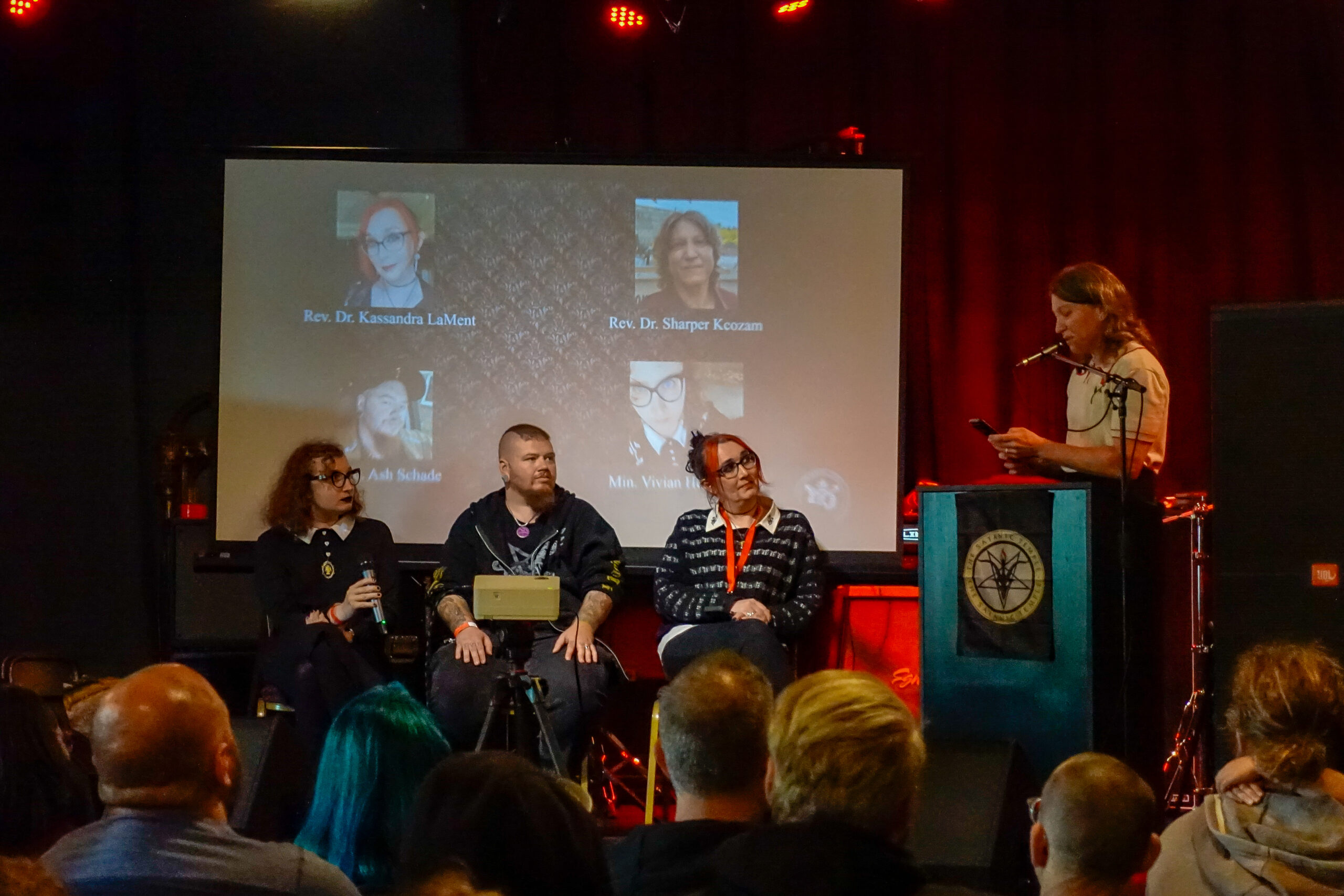
Minister Dr. Sharper Kcozam and Nicole Ballard, co-directors of the Satanic Good Works campaign, explained to us in a recent interview how The Satanic Temple (TST) hopes to help shift the religious landscape by prioritizing “measurable good” over symbolic piety. Grounding their work in tangible, rapid-response mutual aid, TST poses a strong challenge to the traditional monopoly on “goodness” currently held by mainstream religious institutions.
Measurable Good: A Response to the National Day of Prayer
The intentionality of TST’s mobilization is most visible in their global blood drive, which launches annually on the first Thursday of May. This alignment with the United States’ National Day of Prayer is a calculated religious and political counter-statement.
While elected officials engage in prayer breakfasts and spiritual posturing, TST argues that such passivity often results in the government getting “even less done than usual.” In contrast, the blood drive – which spans the entire month of May across the US, Canada, and Europe – posits that the most sacred act is the exercise of using your autonomy to save lives.
The organization, like many of us, views thoughts and prayers as “mostly useless” when compared to the “opportunity to do really meaningful good.” They seek a cultural shift from the metaphysical to the physical, which is essentially a declaration that in a pluralistic society, the legitimacy of a faith should be measured by the life-saving care it provides to the world.
Theology in Motion: Compassion as a First Principle
A persistent reductionist trope views The Satanic Temple as a mere group of “edgy atheists” using religious tax status as a loophole for activism. This shallow-minded framing entirely misses the theological foundation of their work. Ballard is explicit on this point: “We are not anti-religion; we are a religion.”
Their community service is the manifestation of their “First Principle,” specifically Tenet One:
“One should strive to act with compassion and empathy toward all creatures in accordance with reason.”
In short, TST upholds empathy as a religious requirement rather than a secular suggestion. This insistence on religious identity is a bid for plurality in the public eye, demanding that a Satanist’s neighborhood cleanup or blood donation be afforded the same social and legal recognition as the charity work of a Christian or Jewish organization, in the USA and beyond.
A Model for Rapid Mutual Aid
The efficacy of TST’s model was put to the test during the SNAP benefit crisis, where millions faced immediate food insecurity. Their “Devil’s Food Pantry” campaign is really a masterclass in effective mutual aid, mobilizing over 17 congregations across three continents in a matter of days.
The campaign raised between $33,000 and $34,000, and the brilliance of the effort lay in its decentralized execution. Unlike traditional religious bureaucracies that often suffer from “centralized overhead” and “bureaucratic lag,” TST’s funds never touched a central account.
Instead, SGW provided the organizational framework while local congregations performed 90% of the labor, directing donations straight to local food pantries to ensure immediate harm reduction. The entire operation launched and concluded within a single week, providing pantries with desperately needed funds across the country.
“Menstruating with Satan” and Gender-Diverse Care
SGW’s “Menstruating with Satan” program paints a clear picture of the intersectional nature of their work. While many religious charities approach period poverty through a traditional gender lens, TST explicitly addresses the needs of transgender and non-binary individuals, acknowledging that they are disproportionately affected by the systemic costs of menstrual healthcare.
The program’s logistics are designed for accessibility:
• Congregations partner with small businesses to host donation boxes to collect menstrual products, encouraging community-led giving.
• Amazon wishlists allow a global network of donors to ship products directly to local charity partners.
• For TST, using inclusive language, such as the phrase “people who menstruate,” is a deliberate theological act.
The campaign seeks to ensure that these resources are accessible to all human beings who need them, reinforcing their assertion that religious compassion must be as inclusive as it is practical.
An Open Invitation for Collaboration
The Satanic Good Works division operates under the philosophy that their mission is to serve the “greater world,” not just their own congregants. Their aid is for all those who need it, regardless of the person’s religious beliefs.
They also extend an open invitation to other mutual aid groups or like-minded organizations to emulate their frameworks.
They view themselves not as a sequestered sect, but as “members of a community” who are “not scary or evil.” For any organizations looking to bridge the gap between ideology and impact, SGW offers their resources and partnership – you can email them at [email protected].
Faith as a Function of Impact
The results of TST’s labor are becoming more and more difficult for mainstream media to ignore. Their commitment to their annual blood drive has earned them a rank of 42 out of 72,000 teams registered with the American Red Cross – a highly impressive statistic for a minority religion.
They also have multiple abortion clinics providing life-saving reproductive healthcare to women in at-risk states, which we discuss in detail with the director of that campaign, Erin Helian, in “A Conversation with The Satanic Temple: Religious Reproductive Rights.”
Ultimately, The Satanic Temple is challenging us all to look past the “Satanic” label – which is merely a symbol chosen to reflect their values of rebellion against arbitrary authority and is not proof of evil intentions – and focus instead on the actual results of their work.
A religion defining itself by its ability to feed the hungry and provide care to the marginalized is, to many, a necessary reckoning for the mainstream religions.
Should the value of a faith be judged by symbolism and performative prayers, or by its quantifiable, measurable impact on easing the suffering of society today?
You can watch the video version of our interview with Dr. Sharper Kcozam and Nicole Ballard on our YouTube channel.