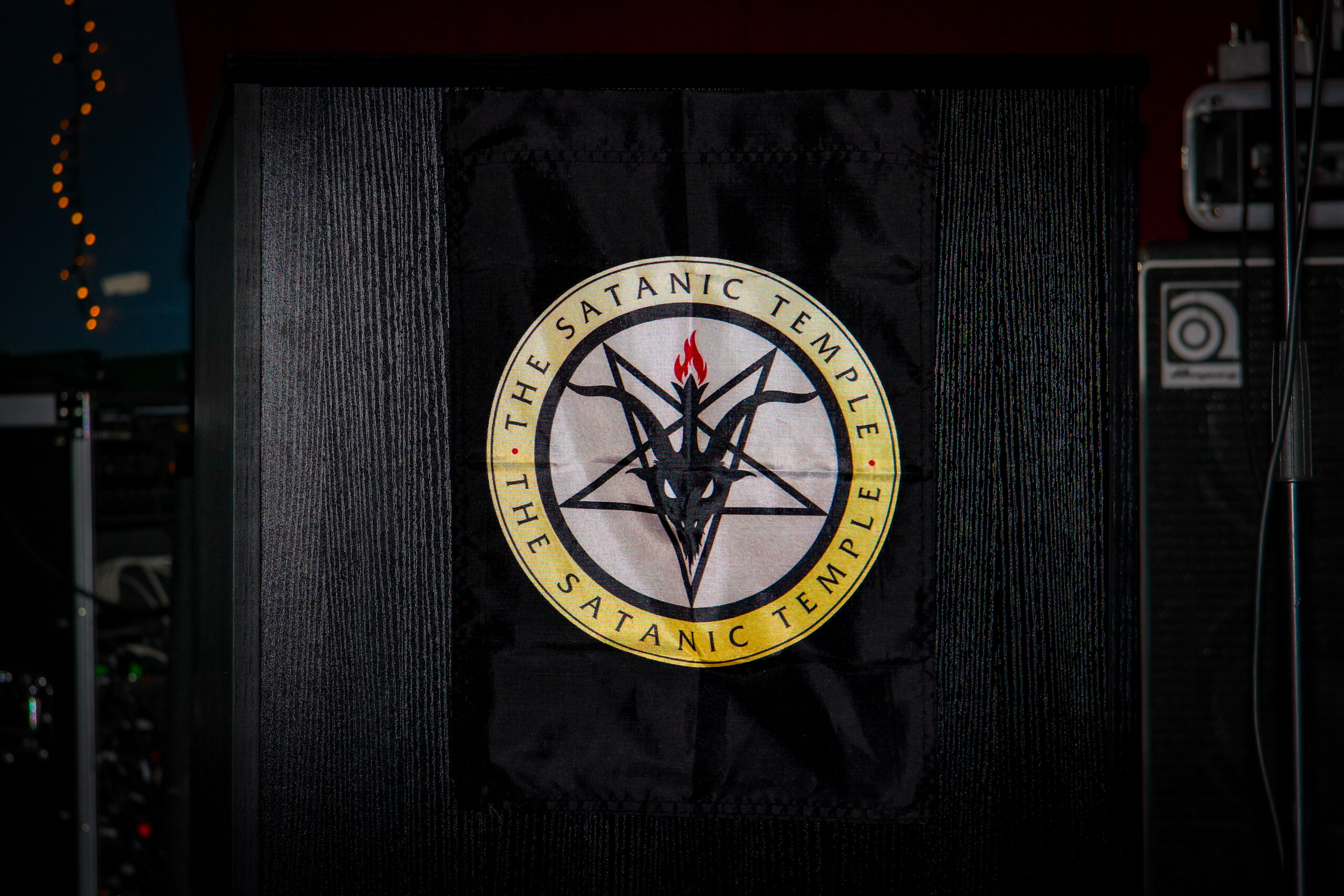
In this interview, Minister Orpheus Gaur and Exarch Io Locke, Director and Assistant Director of TST’s Satanic Representation Campaign, discuss their legal and social efforts to ensure equal religious representation in public spaces and government programs. They explain that their activism, such as challenging Ten Commandments monuments or school chaplain laws, is rooted in the constitutional principle that public spaces must be open to all faiths if they are open to one.
They are fighting for religious pluralism, using the literary figure of Satan as a metaphor for resisting tyranny and theocracy while advocating for First Amendment rights for all. This interview took place at TST’s Satanic Revival event on May 2nd in Baltimore, Maryland, and has been lightly condensed and edited for clarity.
I’m going to jump right in with my opening question here. A federal judge ruled that the Ten Commandments Monument at Arkansas State Capital violated the establishment clause and they ordered it be removed. Can you walk me through The Satanic Temple’s role in getting that established?
Gaur: Yeah. So, in 2013, we used our Baphomet statue to challenge that, in a rally style. We didn’t put it on state grounds, but it was transported in front of state grounds, where they held a rally to challenge that Ten Commandments monument. The judge found that we had every right to put our monument there as they did the Ten Commandments monument, so them saying they have to remove that monument is because they didn’t want to give us equal opportunity to establish our monument as well.
Locke: That case was instrumental in forming what we call SRC today, the Satanic Representation Campaign. So, it’s kind of the reason why we’re both here today.
That was the perfect lead-in to my next question. The SRC’s argument is essentially: if you open public space to any religion, you have to open it to all religions. What has the push back to that argument looked like in practice? What are some of the challenges and hurdles that you have experienced with this campaign?
Gaur: I think a lot of the hurdles are bureaucratic. So, permitting, insurance…it’s essentially been “if you can get through this, then we’ll re-evaluate.” And then we get through it, and it’s more push back. When they put these monuments on grounds, they don’t expect us to challenge them. So, when we tell them that we’re serious and willing to challenge them in court, they really get back on their heels about it.
Locke: Yeah, I think that’s really what happens most of the time. They put up some expectations, say that we have to jump through some hoops, then we do, and they go, “Oh, well, here’s some more hoops, too.” Because they don’t expect us to follow through.
Unfortunately, that makes a lot of sense. Now, Florida’s school chaplain’s law – Governor DeSantis explicitly said that Satanists won’t be allowed to participate. What is your legal and strategic response to that viewpoint? What are your plans of action for that?
Gaur: We spent a lot of time challenging that in different school districts across Florida. Our response to the governor is merely: if you allow a Christian chaplain, you have to allow Satanic chaplains, you have to allow Buddhist chaplains, anybody of any other religion that would like to take part in that, because equal representation is, above all, part of the first amendment.
We found that a lot of school districts didn’t want to deal with the hassle. He left it up to the individual districts, so we would go and speak in front of these districts to, not necessarily say that we’re against it, but explain that if you enact a chaplain program, you have to expect that a Satanic chaplain will be present as well. A lot of them got cold feet, and they decided against it. Actually, a lot of school districts didn’t even talk about enacting any kind of chaplain program.
There are a few school districts, the smaller districts, that did enact the chaplain program, but we haven’t heard of them actually bringing a chaplain into the schools yet. So, we’re monitoring that closely. We’ve been monitoring that for a few years now.
But the fact that he explicitly states that there’s no Satanic chaplain allowed – look on the flip side of the coin. If, in a crazy world, Satanism was the dominant religion, and we said Christians aren’t allowed…flip the coin like that, and it really puts it in perspective.
I think that was a perfect explanation. I can connect the struggles of this with Indigenous religions and how their practices were often and still are forbidden. Have you discussed with other religious groups about these kinds of connections that you have with these struggles, the interconnectedness of them?
Gaur: Our membership is pretty wide in heritage and ancestry. So we do have some internal conversations, and we do have a lot of congregations that are actually part of interfaith groups. That becomes very valuable because they are able to establish a footing in the community to gain allies, even in the Christian faith, but we haven’t necessarily approached or been approached explicitly by other religious organizations, BIPOC or otherwise.
We’re always open for that and we do partner a lot with organizations like the FFRF and the ACLU, who partner with other religions too. Our attitude is that by making sure the door is open for Satanists, we’re making sure the door is open for those other minority religions as well, because if we’re allowed in, then they can have their spot.
The Satanic Pulpit trains The Satanic Temple members to participate in civic discourse such as invocations, public comments, and civic engagement. Why is that training component so important to the campaign? And can you discuss a little bit about what that training looks like?
Gaur: We started the Satanic Pulpit because we request volunteers from congregations to speak against theocratic legislation in their local legislatures, and because ministers give invocations and are in a position of leadership, which they need that speaking skill for. We had a question asked to us of, “What is SRC doing to prepare those speakers?” At the time, our answer was, “well, we work with them.”
So, we decided to establish the Satanic Pulpit, which is a remote public speaking workshop that happens once a month. It’s a short lesson, usually 15 minutes, where we present on a topic. The topic that we presented on last month was philosophical razors, you know, ad hominem, different illogical fallacies, and how you respond to them. The importance of these is giving our members the tools – or the toolbox – necessary to be able to speak with conviction and speak on what they believe and really be able to purvey their beliefs.
A lot of what we do is defend our beliefs from others, and equipping our members with those tools, I thought, was extremely important. One of my greatest passions is the Satanic Pulpit, and we’ll have the testimonies today, which will give you a little bit of a glimpse of that. It still makes me excited. I get giddy thinking about it. So it’s very, very important to me, and it’s very exciting.
We have breakout rooms at the end, and everybody’s excited to participate. We offer a feedback form after every one, and every single time it’s: more practice, more practice, more practice. It’s getting people excited to speak and build those skills.
I’m neurodivergent myself, and it was very challenging for me, even in the position of leadership that I am, to go and speak in front of a school board. The biggest thing for us is speaking in front of hostile audiences and being able to reframe that anxiety of, “no one likes me here.” No one wants to hear me, but they’re going to listen. That’s really what we’re trying to do, give the community skill building and knowledge sharing. We have a very firm belief in doing that.
Yeah. I was reading about it going wow, this is awesome.
Gaur: You’ll see a little bit of that with the testimonies. I’m extremely excited to give participants the ability to practice in front of a live audience, and it just so happens that it’s a very safe space, right? I told everybody, don’t be afraid to fail. Don’t be afraid of stumbling over your words here or there; just pick up and continue. It’s a very valuable experience in my opinion.
Locke: It’s an optional workshop, but absolutely a part of our goal here is to encourage more participation so that we give folks more tools to be able to have conversations, not even just at engagements or in front of their congregation, but one-on-one conversations with other people of different faiths to help them understand that we’re not really sacrificing babies here.
How do you think about the work of the SRC in relation to other civil liberties and rights? For example, LGBTQ+ rights, voting rights, reproductive rights. Do you see those struggles as connected as well?
Gaur: I very much do see them connected. That’s why we partner with with other organizations like the ACLU and the FFRF and Americans United because when you boil it down, we all have a common goal. Ours involves the motivation of our religion as well as representation.
There have been a lot of times where the ACLU or another organization will come to us and ask us to help them, because Satanists are wanting to open that door. It’s a little more concerning for the people who don’t want that door open. The ongoing struggle for justice is shared commonly between all of these organizations, and us as well, and all the goals are interconnected.
Locke: Yeah, and our position is absolutely not just for us. We want to fight for everybody’s right to the first amendment. We want to fight for everybody’s right to freedom of speech and to be able to practice their religion unto themselves. It’s not just for us. That’s our primary focus, but we want to make sure that we’re reaching out for others too.
Gaur: One of the major concerns is the dialogue around the separation of church and state, and this idea that it’s meant to prevent government intrusion into religion and not religious intrusion into government. That’s where the direction gets concerning, right? Because obviously, that’s not how the founding fathers intended that. I think being able to to to work with these other organizations towards that goal of “no, this is how it should be” is valuable.
Absolutely. My last couple of questions: What does it mean to you personally to be fighting for this religious theory? What was the motivation you had for beginning?
Gaur: For myself, I grew up a Southern Baptist – or in the Southern Baptist family, I should say. I was baptized as a child; I didn’t have a choice. So there’s a lot of religious trauma, and it’s quite traumatic for the general population now, if you’re outside of a majority religion in the country. It’s traumatizing to see so much theocratic encroachment. The war in Iran’s a holy war, right? All that propaganda.
I personally have a very strong sense of justice. I believe that no matter what I do, as long as I make a small change in the world, then I’m a happy person. This fulfills that void in me of “hey, I did something,” you know? It may not have turned out exactly how I intended or how I wanted, but it helps fulfill my internal sense of justice, fighting for those that may not have their voice elevated.
Locke: For me, I think a lot of it is my coping. This is my coping mechanism for what’s happening in the world right now. It’s very difficult to stay fully aware of what’s happening. I can either bed rot and feel doom and oh my god, this is over, or I can spend my time doing something about it and even if it’s small little things, those little things will add up and change people’s lives.
For the people that we’ve granted those accesses, it has helped them in their life to change the narrative they’ve had of themselves, the narrative they had of their life, and the control they feel. I think that’s really powerful. Using this push that’s going on right now as motivation, it actually lights that internal fire a little brighter, even.
We find ourselves going, “Okay, they just did this. What are we doing about it?” And then we come up with these great ideas. And, you know, some of them are a little more grandiose than what we can do, but usually, we end up being very motivated by these things to be able to make that difference.
As terrible as the world is, seeing people come together to do good has been giving me hope for sure. Last question: What do you want people who have never heard of the Satanic Temple to know about it?
Gaur: Oh, that’s a good question. I think that if they know nothing about The Satanic Temple, I want them to know that yes, we are a religion, we do have our beliefs, but we’re not bad people, right? If we were bad people, we wouldn’t be trying to make a difference in the country like we are.
Satan is not a literal being to us. I think that scares a lot of people because all they see is The Satanic Temple, but it’s a literary figure that we use for the fight against theocracy, tyranny, and arbitrary authority, and we are very firm in our beliefs. I think that’s, at least off the top of my head, what I would say.
Locke: Yeah, I think for me, we named The Satanic Temple for us. We didn’t name it for everybody else. For us, it is a metaphor for a particular view of Satan coming from romantic era literature, right? And so, we didn’t name it for everyone else’s comfort. We named it for our own comfort. That’s our right, and everyone else has the right to structure their religion as they see fit as well.
I do understand that some people see the name and have a little bit of discomfort or panic about it based on what popular media has expressed in the last 100 years. For me, we do this for us, and for us, it means something different than the casual observer.
Looking deeper into anything is a good skill for anybody. We as humans have developed critical thought, or if you’re on the other side of the fence, we were given critical thought as a tool, right? Either way, use it. I think it’s worth it. Look around, and we’re a rag tag group of outsiders, right? We come from different backgrounds, but we can all come together to try to make a difference in the world.
You can watch the video version of this interview on our YouTube channel, or read all our articles on TST by browsing the tag.