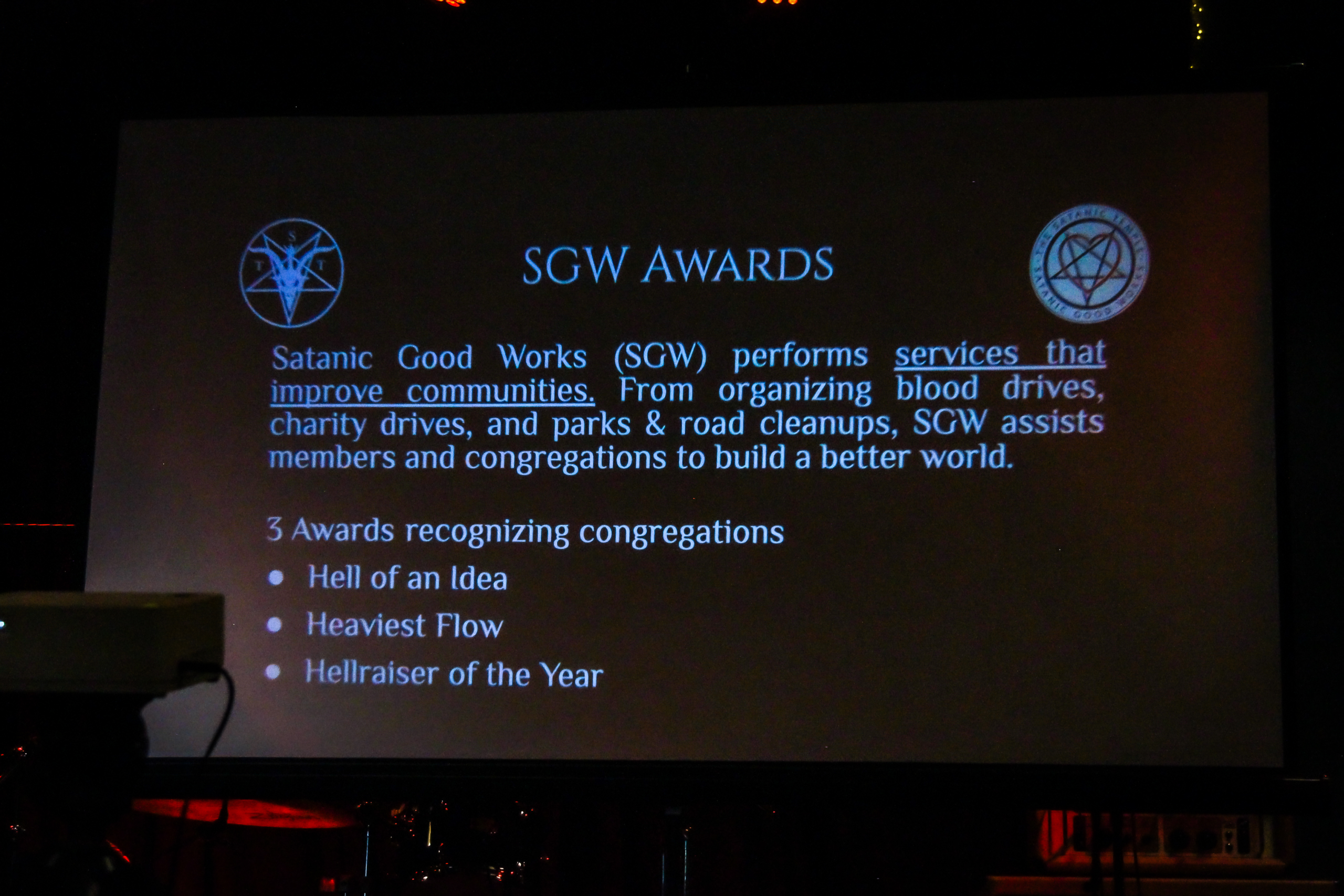
In this interview with Minister Dr. Sharper Kcozam and Nicole Ballard, they discuss the charitable initiatives of Satanic Good Works, a campaign within The Satanic Temple dedicated to community care through direct action and mutual aid.
They walk us through their key programs, including a global blood drive, as well as an initiative which aims to address period poverty with a trans-inclusive focus. This interview took place at TST’s Satanic Revival event on May 2nd in Baltimore, Maryland, and has been lightly condensed and edited for clarity.
My opening question: TST launched a global day of action for the blood drive on May 1st. This is deliberately aligned with the National Day of Prayer. It also happens to coincide with May Day as well. Is that alignment coincidental or is that something that you guys thought about? And then walk me through the thinking behind the choice of aligning it with the National Day of Prayer as well.
Kcozam: It’s not aligned with Mayday intentionally, that just happens to be a coincidence, but it is very intentionally aligned with the U.S. National Day of Prayer. This is The Satanic Temple’s response to that action, which, you know; we view thoughts as mostly useless. A blood drive is an opportunity to do really meaningful good.
Ballard: Yeah. I always think the National Day of Prayer is a day where we have to sit and watch all of our elected officials and people in public office attend prayer breakfasts and things like that, and get even less done than usual. So, this is our response to that, encouraging people to go out and do something good.
Along those lines, what does community service mean within the theology of The Satanic Temple? What is it under your definition? Is it activism, charity, religious practice? Does it fall under all three of those?
Ballard: I think it falls under all of those. I mean, we are a religion. So, like most religions in the world, our members want to do good in their own communities. Sharper and I are very- that’s our job. We’re very focused on that. Not just supporting the congregations in their own local efforts, but trying to create larger international opportunities where people can, again, do measurable good. Go out and do good things in their communities regardless of where they are, regardless of whether they are an actual congregation member, or a member at large, or just someone that follows us on social media.
We just really want to create these opportunities. So, suggesting “hey go out and give blood,” “go out and clean up your neighborhood,” you know, something that is easy for most people to do. It doesn’t take a lot of effort. They can make groups or organize events around it. I think most religions want to do good for their members, for their communities, and for the world.
Kcozam: For us – I’m just commenting on the more religious aspect of it – Tenant One is about compassion and empathy for all creatures. And that includes humans as well as everything else that’s on the planet with us.
I loved reading about the Devil’s Food Pantry; that was really awesome. You mobilized 17+ congregations during this period of economic crisis. What made that level of coordination possible? How did you organize that?
Ballard: Yeah, it really came together very very quickly. Everyone was very aware that SNAP benefits were going to be withheld and millions, literally millions of people, were going to be going hungry. So we very quickly got the word out to the congregations and said we not just want to do something, but we need to do something. It’s our calling to do something.
Very quickly all these congregations came together, and it was US-based because this is really a US problem, although we did have support from congregations in Canada and in Europe, but, it came together very quickly. We were prompting each congregation to get organized, to find a food pantry or some similar service in their own communities.
Good Works provided the framework for the coordination of it, the organization of it, but the congregations really did 90% of the work in collecting the donations for these food pantries, and the funds went directly to them. They didn’t go to TST, we didn’t buy food and distribute it, you know, we coordinated it so it went directly where it was needed, very quickly.
We pulled it together in a matter of days. I mean, it was hectic. I’m not saying it was easy, but it was really beautiful because that was the first time, in my experience, that all the congregations came together for a similar purpose, to do a similar thing. And we collected over, I think, $33-$34,000 that went directly to the food pantries. It’s one of the things I’m most proud of in my entire life, and certainly with this organization, to see what we can do when we put our minds to it.
Kcozam: Nicole keeps saying very quickly, and I just have to throw in that this happened when I was on a week vacation, so I was out of the country, and this entire thing started and was done in that one week.
Wow. Yeah, that is usually how it goes. I feel like it’s always right when it’s the worst moment possible.
Ballard: Yeah, Sharper has excellent timing with their planned vacations.
Don’t we all? When is it ever a good time for a vacation in a world this chaotic?
Kcozam: Yeah, haha.
I also love the Menstruating with Satan program. I love that it addresses period poverty and specifically names transgender and non-binary people as being disproportionately affected by this. How does this trans-inclusive framing shape how the campaign operates on the ground? Does it affect it at all?
Ballard: For Menstruating with Satan specifically? I don’t think so. We’re really trying to be inclusive of everybody that menstruates, regardless of their orientation, regardless of anything. Anyone that’s ever menstruated knows how expensive these period products are.
It’s up to each congregation to decide who their charity partner is, who they want to partner with, and what kinds of groups they want to help. It’s really up to each congregation to make that decision. We do try to be inclusive, but I don’t know that it really plays into that particular campaign.
Kcozam: I think just the way that you’re framing it, even, by saying “people who menstruate” instead of saying women, you know, you take a step back and we are being as inclusive and trans positive as possible just by the way that we even think about that.
Ballard: Yeah, I guess you’re right!
For those who may be unaware, could you explain a little bit about that program and what it does?
Kcozam: Menstruating with Satan? That’s Nicole’s baby.
Ballard: Yeah. It really is. It’s kind of what got me started with Satanic Good Works; I was coordinating the Menstruating with Satan program for our congregation.
It can look different depending on how the congregation wants to set it up. I can speak for our congregation. We partner with local businesses, always small businesses. They allow us to put a donation box somewhere in their business, whether it’s a coffee shop, or a retail store, or something like that.
Usually, the congregations will have an event where they decorate the boxes and create community around that, then we drop off the boxes and the community over the course of the month, or the length of the project, will drop products in there.
We get a good percentage from these business partners that are hosting the boxes. We also create Amazon wishlists so that people, regardless of where they are, can donate products to the campaign, and those typically go straight to the charity partner.
Couple more questions. Sharper, you co-lead both SGW and Transatanic, right?
Kcozam: Yes.
How do you see those roles in relation to each other?
Kcozam: Well, there’s obvious overlap because it’s in the same organization, and a lot of the people are involved in one or both, but I really try to view them as two separate things.
Good Works is more about, I think, creating good works for the general public and all people. Transatanic is an alliance group for people who identify under the trans umbrella specifically, and it’s more about creating a little community within the greater community.
So, who are the people that SGW serves? Are they TST members, donors, recipients, or both? And does that distinction matter to how the campaign functions?
Kcozam: I think that for the most part, the recipients are not necessarily congregants. We’re collecting items, not to give them back to the satanic population or our congregations, but to serve the greater world. However, there have been cases where Good Works has been able to link up resources to members in need. We do that on a case-by-case basis based on what we’re able to offer.
What does SGW offer as a model for secular mutual aid groups and how do you think other organizations could emulate the same things that you are doing to have success in their mutual aid efforts?
Kcozam: We are always looking for other organizations that we could partner with to help and assist in this kind of effort. If there were a group that was curious about how we ran Menstruating with Satan, I think we’d be very, very happy to share those resources.
It’s just a matter of an organization reaching out to us because the two of us, we are the staff of Good Works, and we’re just not equipped to reach out to every other organization. But we’re here to help people. So, we’d be happy to collaborate and share.
Is there a specific email or anything that people could reach out to that would be good for that kind of contact?
Kcozam: Yeah, that would be [email protected].
Wonderful. Perfect. All right, my last couple of closing questions. What’s coming next that people should look forward to from you, from any of your initiatives?
Kcozam: We started out talking about the day of action blood drive, and that launched yesterday. It’s a month-long effort where we encourage people to go and donate blood. Go donate blood anywhere.
We don’t care if you go through our pledging system so that we get the numbers to track how we’re doing, which is great because we’re competitive, but just go out and donate blood and save lives. Let’s increase these resources, these very necessary resources.
Ballard: This blood drive is really a focus; it’s one of the three big projects that we do annually. As Sharper said, and this is an understatement, we are extremely competitive. So, we like seeing the numbers of people pledging. We like our ranking with the American Red Cross. We’re currently ranked number 42 out of like 72,000 teams. So, we’re very proud of that. We’re very proud of the effect that this campaign and this initiative have had in literally saving lives.
That’s amazing. That’s a very high ranking out of that many.
Ballard: Yeah. If we can plug it a little more, if you go to The Satanic Temple website, there’s a banner at the top that says donate blood. The banner should be there, easy to find, all through the month of May because the blood drive is not just one day. It launched on the day of prayer, and it runs the entire month of May.
So, if you go to The Satanic Temple website, you’ll be able to see the banner. Click on that; it will take you to the blood drive pledge page, and it will show you how to do it. And it’s for the U.S., Canada, and Europe, not just the United States.
I’ll definitely do it myself! My last question: What do you want people who have never heard of The Satanic Temple to know about the work that you do?
Kcozam: I want people to know that we are here. We are members of their community, and we’re here to do good. We’re not scary or evil or exclusive. We like to work with anyone who has the same kind of spirit as we do.
Ballard: I think it’s important to me for people to understand that we are a religion. A lot of people want to discount us as a progressive organization that’s just involved in this or that, and it’s very important to us that we are considered to be a religion because we want to be on an equal playing field. We are not anti-religion; we are a religion.
We want people to view us that way, and we want people to see the good work that we’re doing. We’re not out sacrificing babies and doing weird things like that. We’re doing good things in our community. If I could have any wish answered, it would be that I wish people would take two minutes to read our website and our tenants to see what we’re really about.
It was our own choice to use Satan in our name. But if you can get past that and learn a little bit about what we actually do, I think people would have a better understanding of what this organization is.
You can watch the video version of this interview on our YouTube channel, or read all our articles on TST by browsing the tag.