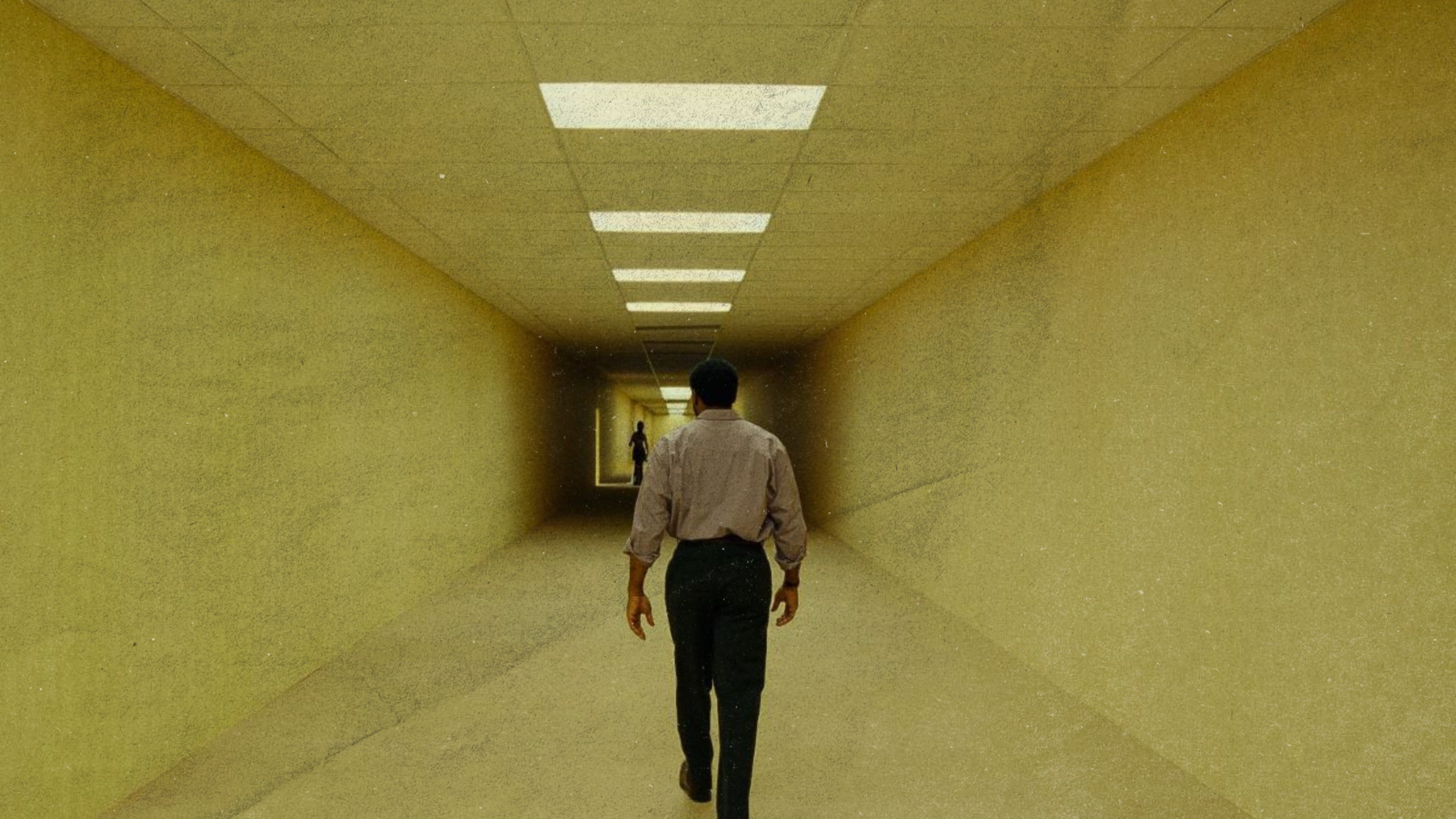
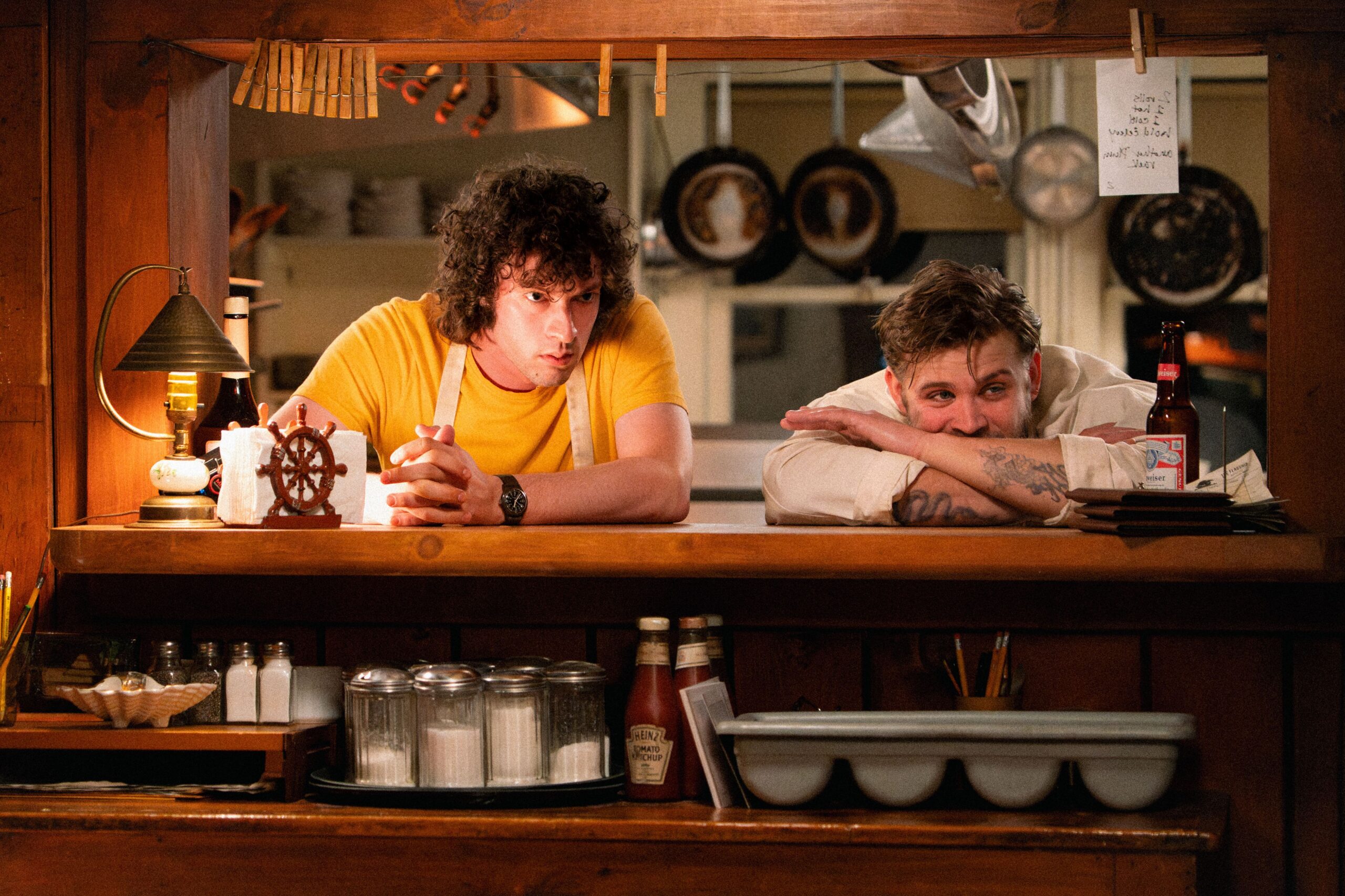
A man walks down one of the halls in the Backrooms. The hall is dark and unsettling, and there's a figure at the end in shadows.
Graphic by The Convergence Lens, Still from A24's 'Backrooms'
14 min read
2,728 words
117 views
This article contains spoilers to Backrooms (2026), so if you have not seen the film yet and do not wish to have anything revealed to you beforehand, please read this piece afterwards!
With the current success of Kane Parsons’ Backrooms, which has become the highest grossing worldwide release for A24 and also one of the top 10 highest grossing horror movies ever in the USA, there comes a question that all studios should think carefully about: what really makes this movie so enticing — especially to Gen Z and Millenials?
Going from Youtube (on channel ‘Kane Pixels‘) to the big screens, we can view this film as another success in the Youtube-to-Cinema pipeline that thrives particularly in the horror genre. We’ve seen this with other projects such as Mark Fischbach’s (Markiplier’s) Iron Lung — which saw decent box office success earlier this year — or Talk to Me (2022) and Bring Her Back (2025) by Danny and Michael Philippou (RackaRacka). Plus, of course, it would be remiss of me not to mention the concurrent success of Curry Barker’s (on channel ‘that’s a bad idea‘) Obsession as well.
What is notable about this trend is two things, first and foremost: they are all independent horror movies with a lower budget, and the movies happen to be the directors’ feature-length debut. Another important factor happens to be their age: Parsons has now become the youngest filmmaker to have a movie at number one in the worldwide box office at 21 years old, Barker is 26, Fischbach is 38, and the Philippou brothers are 33.
Using the criteria set by the University of Southern California on age groups, we can define all of the directors listed above as either Gen Z (born 1997-2012) or Millenials (born 1981-1996). There is already an inkling of answer to my earlier question there — aren’t we (the generations which currently make up the bulk of movie goers and streamers) more likely to be attuned to content made by people from our generation? Isn’t shared culture and shared knowledge what brings us together as a community?
The Mainstream Rise of Internet Indie Horror
The most prominent thing that made all of these movies possible in the first place was the power of an online community. Internet users are the reason these filmmakers were able to secure funding, from Fischbach’s 38 million followers who discovered the game Iron Lung (David Szymanski, 2022) after he played it on his channel and then supported him as he had decided to adapt it, to Parsons’ success adapting the creepypasta concept of the backrooms into a web series on his channel, which is what made A24 interested in developing a movie with him.
Although it certainly helps that fandom spaces can act as a reliable springboard for these new movie directors, I do not think that this is the only reason for the rise of the independent horror genre in particular. Another major factor is the themes that horror is able to explore in a very raw, human way.
“The true subject of the horror genre is the struggle for recognition of all that our civilization represses or oppresses, its re-emergence dramatized, as in our nightmares, as an object of horror, a matter for terror, and the happy ending (when it exists) typically signifying the restoration of repression.”
Horror is one of the few genres which, throughout its entire history, has been used to convey both repression and oppression, and tends to depict marginalized and/or unconventional groups of people. This is why the genre intersects so much with sociopolitical themes. When depicted through the lens of horror’s transgressive nature, topics such as queerness, femininity, and race are often used as a way to denounce — or at least point out — the white-centric, heteronormative, and cisnormative system of hegemony.
For example, we can look to Scream (1998), where the two white male antagonists share an intense, homoerotic chemistry and are shown to be frequently isolated from their peers, who are a representation of the system in the form of white suburban young adults. Or Get Out (2017), in which the black protagonist has to fight for his life and fight against systemic racism as he realizes that his white girlfriend manipulated and tricked him so he would go to her racist family’s gathering where they hoped to bid on his body. Or in terms of feminism — take the trope of the final girl, where the sole survivor ends up being a woman who displays her strength and dominance even in extreme and nightmarish situations.
What does all of the above have to do with Backrooms, you might ask? Well, in my opinion, this film depicts the perfect intersection of these themes. In it, we follow two protagonists: Clark (Chiwetel Ejiofor) and his therapist, Mary Kline (Renate Reinsve).
Both have their personal struggles — Clark suffers from alcoholism which has crumbled his marriage, he wanted to be an architect (but failed) and now owns a furniture store on the brink of bankruptcy. Mary is going through the trauma of her mother being institutionalized and her childhood home demolished.
The two of them represent how the system fails people in different ways. To make things worse, even when Mary turns out to be the final girl, she still ends up trapped by a corporation that was trying to monopolize the backrooms the entire time.
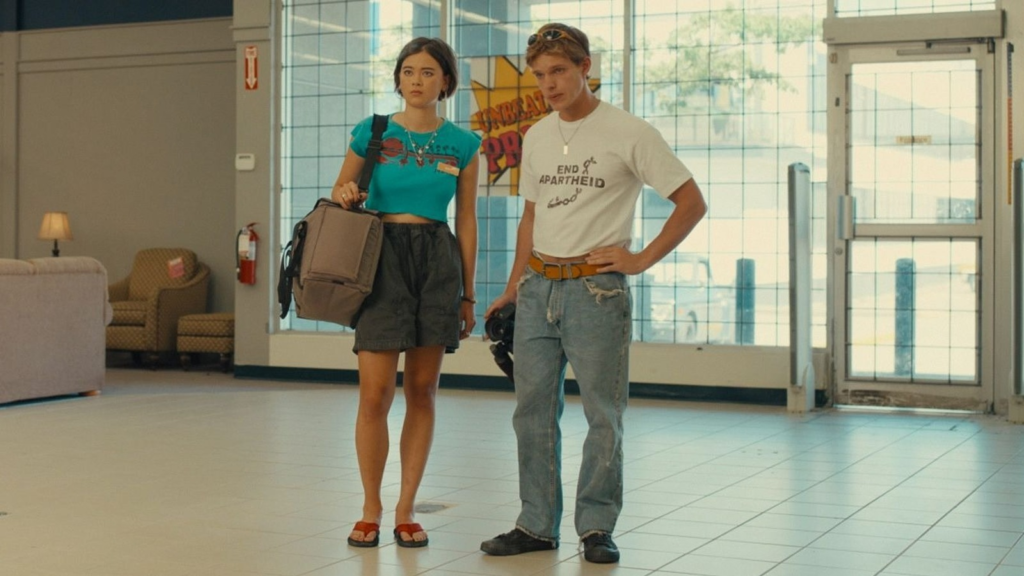
The movie’s political stance is also made clear through its wardrobe: one of Clark’s employees, Bobby (Finn Bennett), wears a t-shirt with written ‘End Apartheid’ on it. This piece of clothing was even used as a prop to show how the backrooms can duplicate items from the characters’ “real world.” The film is set in the early 1990s, when segregation was still written in the laws of South Africa — apartheid began there between 1948 and lasted into the early 90s.
The shirt is a clear denouncement of apartheid from the wardrobe designer, actor, and Parsons himself. We can therefore reasonably interpret this as them standing in opposition to the ongoing apartheid against the people of Palestine, seeing as the Israeli occupation has forced Palestinians to live under unlawful conditions for decades (by International Law’s standards, not that those seem to matter to anyone), and has been compared to South Africa since 1961.
Lukita Maxwell (on the left) and Finn Bennett, who is wearing a t-shirt with the words “End Apartheid” on the front (on the right) in ‘Backrooms’, A24.
In my opinion, this is what really makes this independent horror movie in particular so beloved by its audience: they have chosen to take a clear political stance that is openly denouncing oppression while telling a story that reflects the same worries about capitalism’s failings that the general public has. This is rare, especially after Melissa Barrera was fired from Scream 7 for standing up for Palestine and speaking out about the genocide Israel is committing.
What also plays a huge factor is that these independent directors, as a collective, all loudly and publicly strive to protect the human made (and conceived) art form. Parsons in particular has made his sentiments around the importance of humanity in artistry crystal clear. When asked how he feels about the rapid evolution of AI technology by Geordie Gray for The Australian, he said he gets “no enjoyment” from using AI tools to make his films.
“I think I’m in the same boat as most well-adjusted people. If I could snap my fingers and make generative AI disappear forever, I probably would. Creatively, I get no enjoyment from using those tools. It defeats the purpose entirely for me. […] What interests me more is interrogating it artistically. We already live in a world where you walk outside and there are billboards and signs that are obvious AI slop. That’s become part of our visual reality. To me, generative AI feels less like innovation than a symptom of a broader cultural and economic rot. I’m interested in using that iconography in art — not using AI to make the art itself, but examining what it represents.”
— Kane Parsons, June 2026
Parsons’ anti-AI stance is one that is shared by many, especially amongst Gen Z, as they are consistently the most critical about the usage of AI in the workplace. The percentage of Gen Z that is enthusiastic about AI has declined by 14% since 2025. Ironically, this month, the same month as Parsons’ interview, the very studio that produced his movie, A24, has announced an AI partnership with Google’s DeepMind, which has already faced backlash and to which A24 has already released a statement explaining that they want to have “a seat at the table.”
Even though A24 is an independent one, this still demonstrates how these larger studios are disconnected from their audience, especially since, as mentioned earlier, the biggest movie-goers this year in the USA have been Gen Z and then Millenials. The anti-AI sentiment has only grown stronger in the horror community after the backlash on Scream 7 (yep, this movie again) where Spyglass partnered with Meta for a collaboration where people could AI their face into the movie and used AI deepfakes as a nostalgia-bait plot within the movie to attempt to regain the audience they lost when Barrera was fired.
Speaking of nostalgia, this is another reason for why these indie movies are so popular: they are original movies (or original adaptations of another medium). As movie consumers, the audience is experiencing something that Hollywood is evidently still struggling to comprehend: franchise and remake fatigue. People want fresh, new ideas, not endless sequels.
Although these films may do well in the box office, they are not often remembered in the pop culture lexicon for long. Horror is not the only genre that is victim to this; Shrek 5has also been used to talk about sequel fatigue, for instance, and so has The Devil Wears Prada 2, with audiences split between feeling like it had too much and just enough reliance on nostalgia. Another example is Alex Garland (screenwriter of 28 Days Later) partly blaming Marvel for the infinite sequel issue. I do think that this is a global issue within the movie industry, and we’re seeing it more and more often.
Liminal Spaces as a Reflection of Our Society
In terms of setting, Backrooms and Iron Lung are fairly close to each other when you think about both films exploration of unearthly liminal spaces. The popularity of this trope makes sense — after all, what is more unsettling and horrific in a society full of nothing but “cultural and economic rot” than empty, soulless liminal spaces?
“Liminal spaces are surreal, often empty places of transition that may also have some sort of nostalgic appeal. These kinds of places are the subject of an internet aesthetic, or popular online visual art style, consisting of images of empty or abandoned locales that appear eerie to the viewer. Images of liminal spaces often evoke a sense of unease, likely because of the “uncanny valley” effect produced when familiar spaces are observed outside of their normal context.”
The concept of the “backrooms” started as a post on the website 4Chan in 2019 discussing “disquieting images that just feel off.” This aesthetic then saw an increase in popularity on Internet with the 2020 COVID lockdown, because the emptiness of all the places that used to be crowded left that “uncanny valley” impression on people. The lore behind liminal spaces goes much further; it has many sub-genres as well, such as empty malls or restaurants.
Liminality can be horrific, and losing your ability to discern what’s real and what’s not plays a big part in that. This is explored in Backrooms with the furniture that the backrooms does not fully comprehend and therefore doesn’t recreate to perfection; even people are only impressions (or memories) of people within them. As Clark tells Mary, it is as if someone who has never seen a dog before described one to someone and they had to draw it from that.
When you hear “liminal spaces,” you may also think of Five Nights at Freddy’s, which originally takes place in an abandoned restaurant where you are the night guard who has to survive while being haunted by the restaurant’s animatronics (a clear parody of the Chuck E. Cheese restaurant franchise).
Exit-8 (2025) is another movie that tackles liminal spaces, but this time within a subway system that acts like an escape room which becomes deadly and will make you start over and over again if you fail. It is quite similar to Backrooms, in some ways, although the ending is happier and its goal is to help the protagonist navigate through the idea of paternity rather than explore systemic failures.
We can interpret this new perception of horror as a direct social indicator: it represents the way both Millenials and Gen Z have seen their environment evolve. From the 2008 economic crisis to the current recession, places that were the very legacy of a glorious economic past have been left abandoned. The channel Bright Sun Films on Youtube has a video series called Abandoned and another one called Bankrupt in which they investigate abandoned places and bankrupt companies across the USA.
From huge malls to restaurants and entertainment parks, there are a lot of different places that we’re slowly losing. The concept of a “dead mall” is one that is relevant to both culture and politics, as it mostly started with the 2008 Recession — malls got emptier and emptier as stores closed, slowly became abandoned, and started to deteriorate. Most of these places have stayed frozen in time, as it would be too costly to renovate or demolish them. Additionally, the rise of online shopping sealed their fate even further. Clark’s furniture store in Backrooms represents the beginning of this decline, as it is essentially a ‘dead’ store, meaning little-to-no customers are coming in.
Millennials and the older half of Gen Z have been able to experience the decline of these spaces in real time. Personally, I still remember the joy of going to malls as a child, the way they were full of life, full of shops with things you couldn’t find anywhere else. It remains a shock when I go back there to this day. Many shops have been left empty or replaced, and you would think they never existed in the first place if it were not for the old, decrepit, forgotten signs or posters.
“Many of the liminal spaces online are connected to places that had a lot of life during their childhood. […] Malls and abandoned schools are prominent visuals in both found footage horror, analog horror, and liminal horror. Malls especially come up a lot because they used to be a big epicenter of socialization and commerce, and now it’s this visual of decaying consumerism, so it reflects a lot of interesting nuance between places that used to have something and don’t anymore.”
Horror movies are using liminal spaces to put an emphasis on the discomfort that arises from seeing these locations we used to know so well end up completely empty, and from being left with nothing but ourselves and our thoughts. It is a way to acknowledge how consumerist society has been bulldozing its way through our lives — when something is not working anymore, it is discarded and becomes a remnant of the past. That is why the trope is so popular amongst Gen Z and Millennials; it directly resonates with their experience of these spaces.
The message that studios should take away from the success of these films is not to scour the internet for the next copypasta to turn into a blockbuster hit; it should be to invest in young creatives again, to provide them with the funding for their projects that used to be more accessible than it is to filmmakers today. Many young filmmakers are eager, talented, and intellectual in ways that speak more enticingly to audiences their age. They deserve more opportunity.
What are your thoughts on liminal spaces? How do you feel about this kind of horror trope and its connection to society? Do you agree that studios should invest more in younger filmmakers? Leave a comment and let us know!
The Convergence Lens is an independent, reader-supported publication. Every article we write is only possible because of supporters like you. The most impactful way to support The Convergence Lens is to join our community as paid members, or contribute a one-time donation. If you have the means to, we would greatly appreciate your support.
Dean is a TV/Film critic and journalist who specializes in the study of creative industries, queer/gender studies, media representation and fan participatory culture. He analyzes subjects with an academic scope and draws focus to patterns within systems. He is based in France.
Dean is a TV/Film critic and journalist who specializes in the study of creative industries, queer/gender studies, media representation and fan participatory culture. He analyzes subjects with an academic scope and draws focus to patterns within systems. He is based in France.
This article is licensed under Creative Commons (CC BY-NC-ND 4.0), and you are free to share and republish under the terms of that license, but you must be in accordance with our policies.
If you wish to republish one of our available articles, you may do so only under the following conditions:
You must:
Credit The Convergence Lens and the named author
Include a line at the top: “This story was originally published by The Convergence Lens” with “The Convergence Lens” hyperlinked to the original article
Use canonical metadata pointing to the original URL if possible
Retain all original hyperlinks
Keep the original language (you may only make changes to reflect time, location, or style. If you would like to translate, please instead reach out to [email protected] for us to partner together)
Have a prominent way for us to contact your organization
You may not:
Edit our content beyond time/location/style adjustments without consent
Sell advertisements specifically on behalf of The Convergence Lens
Solicit donations on behalf of The Convergence Lens
Sell or syndicate our material separately
Use our content for SEO manipulation, ad revenue farming, or AI training purposes
Republish our content automatically or in bulk – you must select individual pieces
Republish accompanying photographs, graphics, or illustrations unless separately licensed
Images and multimedia:
You may leave out our images or use your own
Do not republish our original graphics, photography, or video without explicit permission
Christopher Nolan’s IMAX epic of Homer’s poem is gorgeous, brutal, and full of ambition. It’s also proof that even our most sincere anti-war stories are still being told by people who cannot picture what comes after the empire falls, only what a gentler version of it might look like.
In this summertime coming-of-age story, Dominic Sessa portrays a young, cocky Bourdain, who drives you a bit insane with his bad decisions but has you rooting for him nonetheless.