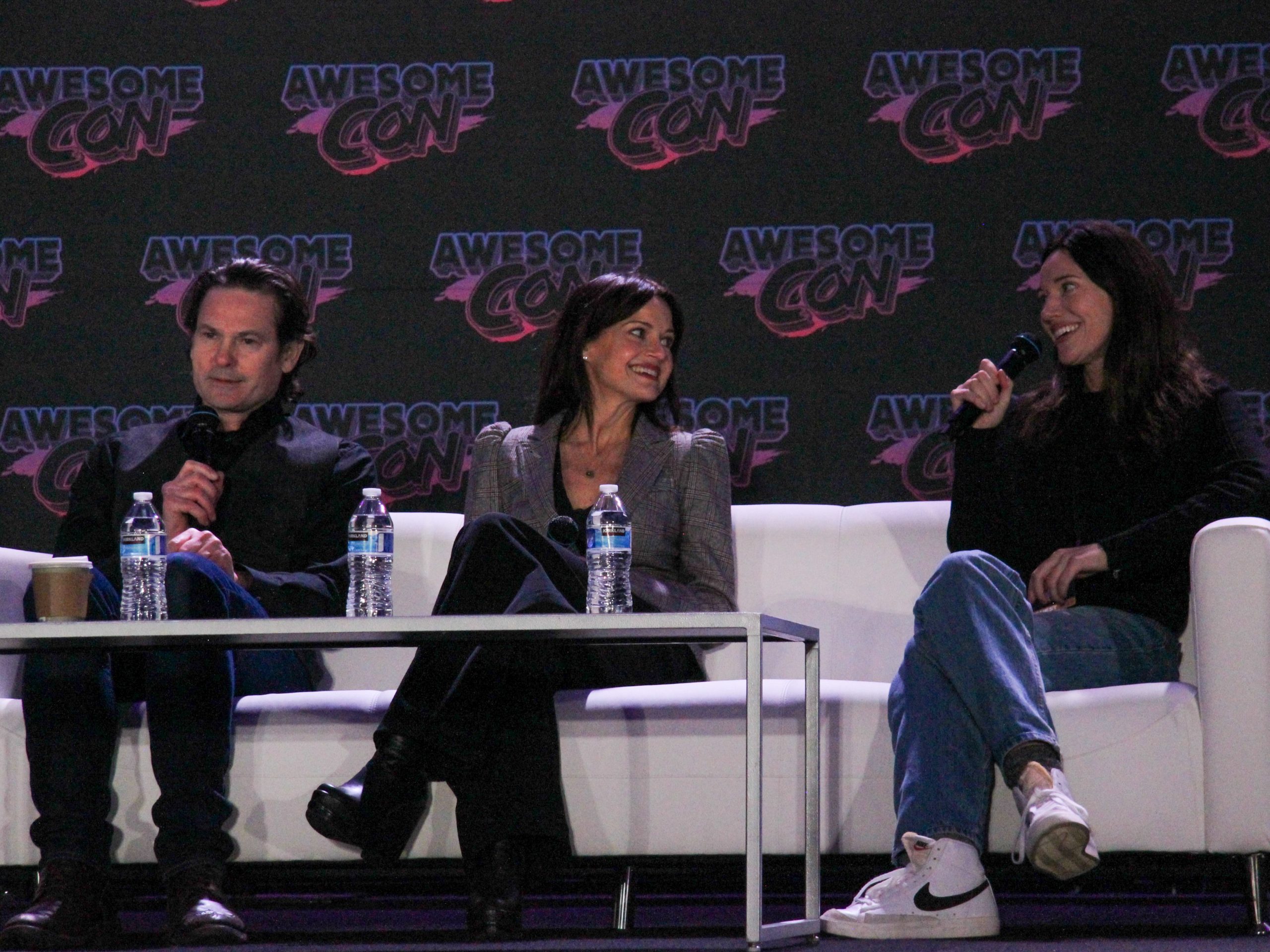
The timing of the Flanaverse panel at Awesome Con happened to (or was planned to) align with news that had broken earlier in the week: Mike Flanagan’s next project will be a new adaptation of The Exorcist, now confirmed to star Carla Gugino, Scarlett Johansson, and Diane Lane. It’s the largest cast Flanagan has assembled for a single project, and it arrives at what feels, at least from the outside, like a defining moment in his creative trajectory – the point at which arguably the most politically resonant horror filmmaker working in television today gets handed one of the most culturally loaded franchises in the history of the genre. We’ll go more into what that means in a moment.
First, for anyone who hasn’t yet found their way into the Flanaverse: let us make a case for why you should.
What the Flanaverse Is
Mike Flanagan has spent the better part of a decade building one of the most coherent bodies of work in contemporary television – a series of horror projects that are, on the surface, about ghosts and cults and crumbling institutions, and just below the surface, are about everything happening in politics right now. The Haunting of Hill House (2018). The Haunting of Bly Manor (2020). Midnight Mass (2021). The Midnight Club (2022). The Fall of the House of Usher (2023). Threading through almost all of them: a repertory company of actors who return, in new roles, to serve different corners of the same larger project.
Flanagan’s visual style is immediately recognizable to those familiar with his work, but what really holds his projects together is a set of recurring concerns: addiction and its devastation of families, the way institutions protect themselves at the expense of the people inside them, the seductive authority of charismatic men, and the costs, paid overwhelmingly by women and the marginalized, of a world organized around the comfort of the powerful. These are not subtle political texts, even when they are wrapped in extremely effective monster-delivery systems.
“One of the really noticeable things in all of the work that he does,” Gugino said during the Awesome Con panel, “is that Mike is interested in always going to the more complex, and the more nuanced, and the less obvious.” She was talking about the ending of The Haunting of Hill House, about his move of giving a harrowing story a sense of hope, but the observation holds across the whole of his work. Flanagan doesn’t simplify, and he doesn’t reassure. He goes toward the thing that is harder to look at and stays there until you understand the point he is making.
Horror as Political Truth-Telling
The Haunting of Hill House is, at its core, a story about the way addiction moves through families – about the way one person’s disease radiates outward, reshaping everyone around them, and the way those around them develop their own coping mechanisms that become their own pathologies. Nell’s spiral, Steven’s emotional unavailability, Shirley’s rigidity, Luke’s addiction itself: the show depicts how families get shaped by suffering that no one chose and that no amount of individual effort can simply fix. It is a political argument about addiction and the failures of American systems of care, wrapped in the architecture of a haunted house story.
Midnight Mass is a story about what happens when a charismatic religious leader introduces an outside doctrine into a vulnerable community and uses the community’s faith and suffering to build something monstrous. If you watch it in 2026 and you don’t feel a chill that has nothing to do with Father Paul’s late-night walks, you may want to check the news. Flanagan renders with terrifying clarity the process by which good people get swept up into something that promises them meaning and gives them horror, the gap between what the leader says and what the leader is, and the speed with which that gap can close around a community once it starts believing.
The Fall of the House of Usher is perhaps his most blunt political analogy: a fictionalized autopsy of a pharmaceutical dynasty, the Ushers standing in unmistakably for the Sacklers, and the show is not interested in ambiguity about the verdict. These people knew. They profited off people’s suffering. They are being judged for it. Katie Parker’s Annabelle Lee gets the final monologue of the series, and during the Awesome Con panel, Parker described it with something close to awe – the sense, she said, of “a spiritual element” to the work, of resolution and justice being enacted through language, through a woman’s voice in a cathedral.
Bly Manor is subtler – a story about grief and guilt wrapped in a British ghost story, but with same-sex love at its center, handled with the kind of matter-of-fact normalcy that makes its tragedy land that much harder. The horror is homophobia, internalized and external, as much as it is anything supernatural.
Gugino and the Flanaverse
Carla Gugino has appeared in more of Flanagan’s work than almost anyone else in his Rolodex, and she explained why to the audience during the Awesome Con panel. She described a feeling of mutual trust, that repertory-company vibe we mentioned, and the joy of working with people who truly “come to play.” She also spoke to something more specific which motivates her continual return: the sense of safety that Flanagan’s sets create.
“He provides an environment in which you can jump off the cliff, because you feel safe enough creatively,” she said. “He provides a strong vision.”
What Gugino brings to that environment is a unique kind of anchoring. She played Olivia Crain in Hill House – the mother at the center of the family’s devastation, a woman whose love for her family and whose fragility under enormous supernatural and psychological pressure become the emotional axis around which the whole show turns. In Usher she played Verna, Flanagan’s version of a supernatural arbiter – a figure of consequence and moral authority, shifting across eight different physical forms across the series. She described working with movement coach Terry Notary to find the physicality of each version of Verna, the way the character’s essence had to survive translation across radically different physical expressions.
In both cases, her presence brings something specific to the story: it provides the emotional and moral center of gravity that keeps these politically freighted stories from becoming polemics. Verna in Usher is not merely an agent of punishment; she is something more like grief made visible, a figure who holds the Usher family accountable, not through righteousness but through consequence. In similar fashion, Olivia in Hill House is not merely a victim; she is the fullest possible rendering of what the show is about – the way the people we love most can become, through no real fault of their own, the agents of our deepest suffering. Gugino makes the argument without arguing in the way she brings these cautionary tales to life.
The New Exorcist
The news of Flanagan’s Exorcist landed this week, which is a project that feels both surprising and, in retrospect, inevitable in this era of revival/reboot-focused Hollywood. Knowing it is in Flanagan’s hands offers comfort, at least. Gugino is in it, and so are Scarlett Johansson and Diane Lane – it’s the most star-studded assembly Flanagan has worked with thus far. The franchise itself, originating with William Peter Blatty’s 1973 film, is one of the most durable in horror history. It is also, like most of the properties Flanagan has taken on, a text with layers waiting to be excavated. The 1973 Exorcist is, in the most generous reading, a film about faith in extremes; in the less generous reading, it is a film about what happens to a girl’s body when the grown-ups around her don’t listen and the church arrives to inflict violence upon her in the name of God’s salvation.
I suspect that is similar to how Flanagan will read it. His instinct, as Gugino and the other panelists made clear, is toward the human rather than the supernatural, toward the question of what a story is really about rather than what it is visibly about. The Exorcist in Flanagan’s hands, with Gugino and Johansson and Lane at its center, will be something to witness, to say the least.
It’s the right moment for it, too. The appeal of horror has always been partly about the catharsis of confronting, in the safe container of fiction, things you’re not allowed to look at directly due to societal influences and pressures. In 2026, those things are not in short supply.
Why We are Drawn to the Flanaverse
At the beginning of the Awesome Con panel, the moderator asked a question about which of their character’s endings lingered most to the actors, and they all gave incredibly thoughtful answers – Parker on Annabelle Lee’s monologue, Gugino on the hope in Hill House‘s ending, and Thomas on the beauty within Midnight Mass‘s tragedy.
But I think the answer to why we are so drawn to these projects is simpler and more uncomfortable than his ability to write these lingering endings: Flanagan’s work is popular because it tells the truth, and not the flattering truth, nor a truth that resolves cleanly. His horror is popular because his horror is accurate to the world around us.
In a political moment defined by the systematic dismantling of accountability and the mainstreaming of impunity, there is an enormous hunger for art that names what is happening. Flanagan names the failings of capitalism using the language of ghosts and monsters as opposed to corporations and CEOs, and people are hungry for it.