

When I first watched this TikTok by creator @therealebjohnson, my instinct was to be skeptical. Not because I thought the possibility of a billionaire using a PR team for damage control was far-fetched, but because I am inherently skeptical of everything I see on the internet. Then more and more people voiced similar thoughts.
So, I decided to do some digging of my own.
Now, in the interest of transparency (because that matters to us even if it might not to mainstream outlets), I am not the biggest fan of Taylor Swift. Never have been. However, I always try to keep my criticism of anyone related to the facts. Conspiracy has never been my thing.
Just like with all of my investigations, I am sticking to those facts. This article is analysis and commentary based on publicly available information, including corporate reports, media articles, LinkedIn profiles, and business filings. My main concern here has little to do with Swift and a lot to do with the potential for a sharp increase in journalistic malpractice and the erosion of our media due to AI influence that is on the horizon, if what I found here is any indication.
In case you missed it, Rolling Stone published this article last week, claiming that criticism of Swift’s latest album was fueled by a coordinated bot attack, citing a study published by a company called GUDEA. Within 48 hours, the story had been picked up by dozens of other outlets. The narrative is that sophisticated bad actors were deploying bots to smear one of the world’s biggest pop stars with false Nazi accusations.
Seems reasonable enough at face value, sure, but if you do even the slightest bit of research into GUDEA, everything falls apart. It seems like almost none of the outlets bothered to investigate what this company actually was, who was behind it, or whether their claims held up to scrutiny.
So What is GUDEA, Exactly?
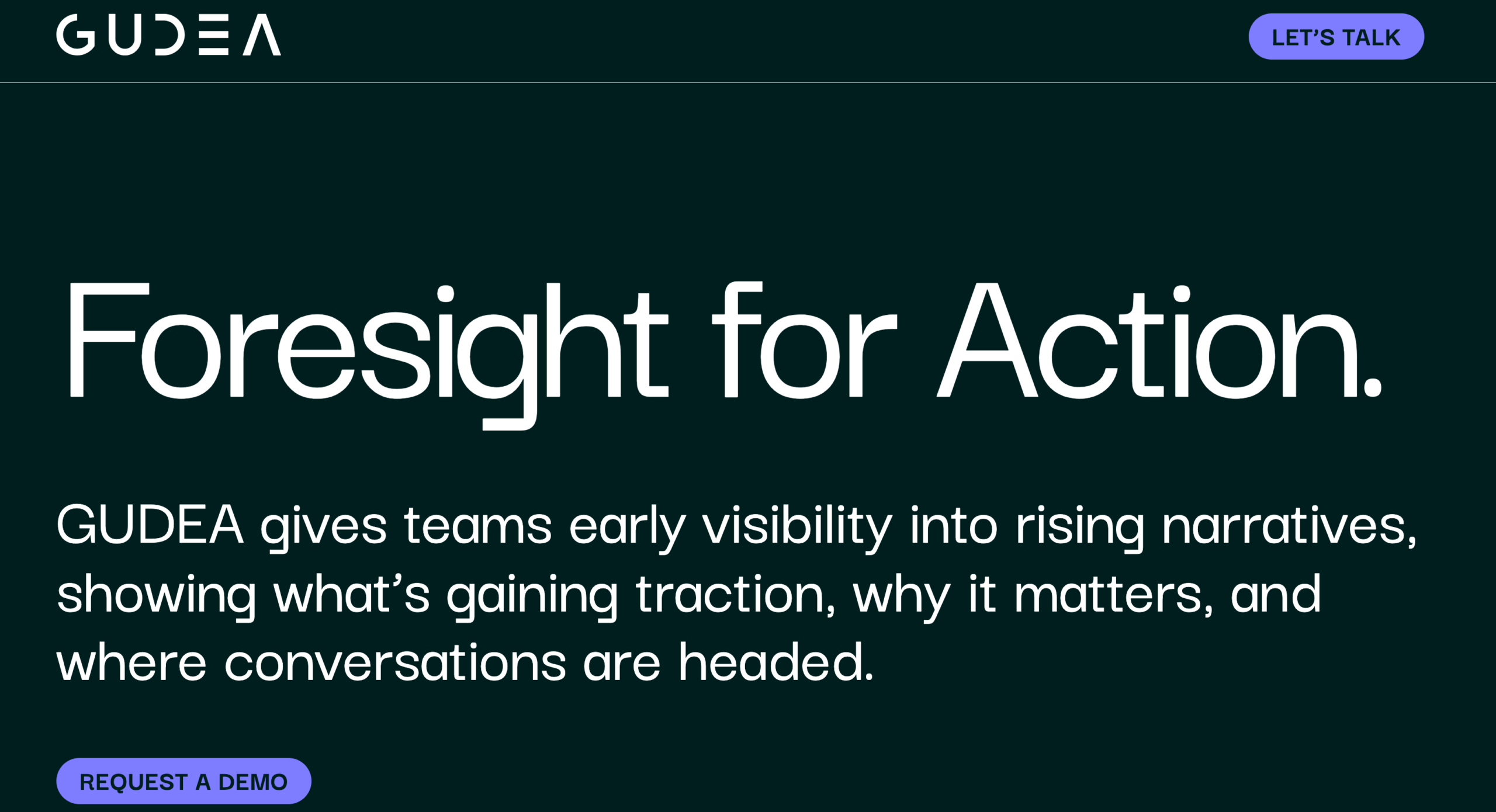
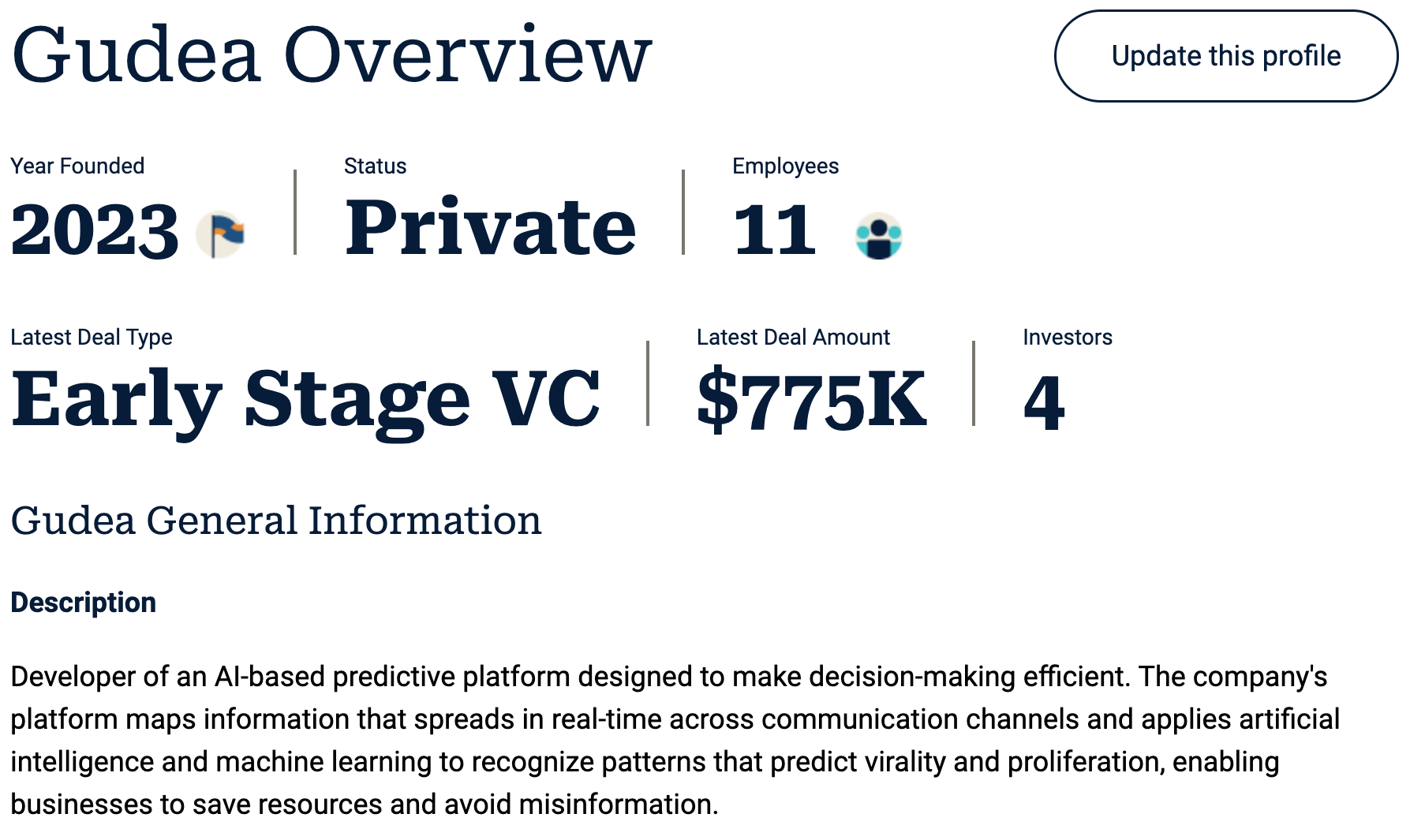
Despite using GUDEA.ai as their domain, GUDEA is not an AI company in the academic sense, nor is it a research company. It is a venture-backed startup in the “reputation security” SaaS sector. GUDEA presents itself as an “AI-powered narrative intelligence platform” that helps clients detect “coordinated inauthentic activity” and predict reputational threats before they escalate. Founded in April 2023, the company is less than two years old. According to Crunchbase, GUDEA has raised between $2.06 and $2.93 million across two funding rounds.
Groove Capital, Bread & Butter Ventures, Service Provider Capital, and Techstars are the only investors publicly listed. These are early-stage venture capital firms betting on a software solution to a market problem – in this case, the anxiety that brands and public figures have over online reputation. These investors expect 10x returns on their capital. They invested in GUDEA to build a scalable SaaS business that can eventually be acquired or go public. Their goals are not to advance the scientific understanding of online behavior.
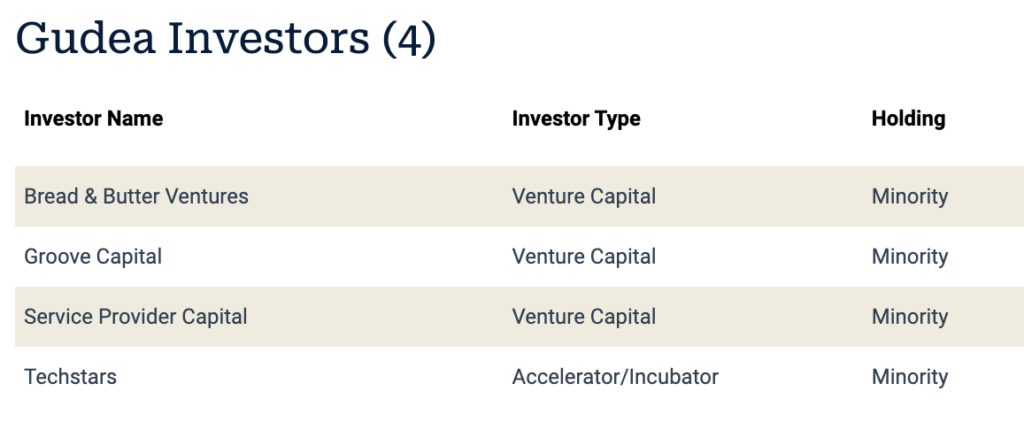
Let’s examine each of these companies just to be thorough:
- Techstars
• Type: Global startup accelerator & venture capital fund. One of the most well-known and prolific accelerators in the world.
• Model: Invests a standard amount in exchange for a highly structured, 3-month mentorship-driven program. It’s designed to rapidly refine a startup’s business model, pitch, and network to prepare it for a larger “Seed” funding round.
• Background: Techstars runs hundreds of programs, some generic, some thematic (e.g., Techstars Music, Techstars Equitech). The primary value with them is network access. They are introduced to hundreds of mentors and a vast alumni network. For GUDEA, this was likely the launchpad that connected them with advisors, early clients, and follow-up investors. GUDEA’s Client Experience Manager previously worked at Techstars. Investing in a company founded or staffed by someone from your own network/ecosystem is a classic VC move. - Bread & Butter Ventures
• Type: Early-stage (Pre-Seed & Seed) venture capital firm.
• Model: They invest in “the intersection of bits and atoms,” meaning software (bits) that interacts with or transforms physical industries (atoms). They spotlight Food Tech, Ag Tech, Supply Chain, Industrial Tech, and the “Future of Work.”
• Background: GUDEA is solely SaaS/software (bits) analyzing online discourse (more bits). It doesn’t touch a physical industry, which is Bread & Butter’s proclaimed sweet spot, which means their “Future of Work” focus is the more likely in for GUDEA. They could’ve been pitched as a “Future of Work for Communications/PR/IR” tool, an enterprise SaaS platform for large industries where perception directly impacts physical-world value (stock price, brand sales, election outcomes, etc). - Groove Capital
• Type: Early-stage (Pre-Seed, Seed) venture capital firm.
• Model: Based in Minneapolis, they have a broad thesis focused on “exceptional founders” in the Midwest (and beyond). Their portfolio is a mix of B2B SaaS, consumer, and tech-enabled services.
• Background: This investment is likely a bet on CEO Keith Presley himself given his political strategy and Navy background. Groove Capital often backs non-traditional tech founders. GUDEA’s Client Experience Manager also previously worked at Groove Capital. - Service Provider Capital
• Type: A specialized venture capital firm.
• Model: They invest exclusively in B2B companies that are founded, owned, or led by former service providers (consultants, agency owners, freelancers). Their belief is that these founders have a unique insight into high-value, underserved enterprise problems because they lived them.
• Background: Once again, we can look to Presley. He ran a political strategy firm (Pad & Pen Strategies) and was a senior exec at a political media firm (Good Fight). He was the service provider. This firm invests explicitly to turn high-end, billable-hour expertise into software companies. They are likely betting that Presley can automate and scale the art of political opposition research and narrative framing for the corporate and celebrity world.
Techstars is one of the world’s most prominent startup accelerators, running the same playbook since 2006: select promising early-stage companies, provide $220,000 in funding plus mentorship, take 5% equity, then push companies through an intensive three-month program focused on finding “product-market fit” and preparing for Series A fundraising.
This model is designed for one thing and one thing only: rapid commercial growth. Companies go through the program, get connected to investors, get coached on pitching and scaling, then graduate to their “Demo Day” where they present to 100-200 investors. The goal is always the same: prove you can make money fast enough to justify bigger checks.
Bread & Butter Ventures, GUDEA’s lead investor, focuses on enterprise SaaS companies that can sell to Fortune 500 corporations. Their managing partner, Brett Brohl, previously ran Techstars’ Farm to Fork Accelerator. The firm maintains corporate partnership programs with companies like Target, 3M, Cargill, General Mills, and Mayo Clinic – exactly the kind of enterprises that might pay for “narrative intelligence” services.
To sum all of that up for you, GUDEA’s early investors are irrefutable proof that this is a company built not as a research organization, but as a venture-scaled endeavor into software services made specifically for the purpose of assisting brands and public figures. Their mandate is growth, client acquisition, and proving their product’s efficacy, meaning a public, high-profile “win” such as exposing bad actors for a famous singer would be very, very good for them.
And GUDEA certainly isn’t shying away from using this massive news cycle to their benefit.
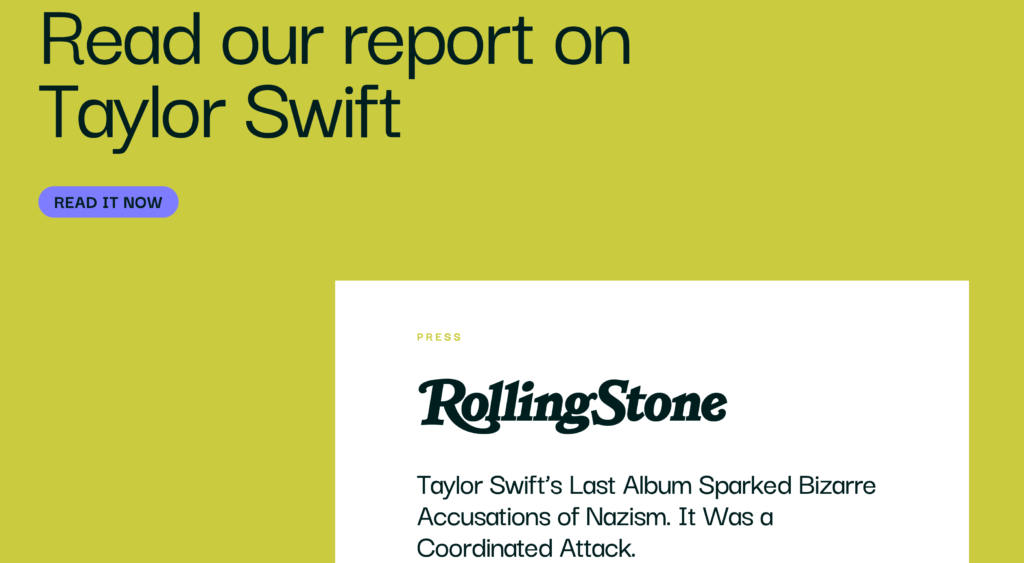
As you can see, they got it up on their homepage with a swiftness – pun intended.
And it makes sense! This study serves their commercial objective perfectly. It is “proof” that GUDEA’s tool can detect what normal people cannot: the invisible hand of coordination behind criticism. For celebrity publicists, brand managers, and crisis communications teams, this study is the perfect sales pitch. Look what happened to Taylor Swift. Your client could be next. You need GUDEA to protect yourself.
But at the end of the day, the most important question is: does GUDEA even have the expertise to conduct a study like this?
To answer that, I looked at their publicly available staff members.
The GUDEA Team: Where Are the Researchers?
As I suspected, GUDEA does not have the in-house expert team one would expect from an actual research entity, such as Graphika or the Stanford Internet Observatory. Instead, it has a team built to sell, service, and apply narrative intelligence tools to clients in politics and entertainment.
A research institution studying social media manipulation, bot detection, or network analysis would employ people with credentials such as: PhDs in computational social science, network science, or data science; published peer-reviewed research in relevant journals; academic appointments or current affiliations with universities; expertise validated by the scientific community.
GUDEA has exactly zero of these people.
Here is a breakdown of the team, pulling from public LinkedIn profiles, websites, and interviews:
1. The Founder & CEO: Keith Presley
Education: B.S. in Environmental Science from University of Maryland. No graduate degrees. No technical training in data science, network analysis, or computational methods.
Background: Professional history in political strategy and campaigning (Pad & Pen Strategies, Good Fight Political, Yang2020, Chris Van Hollen for Senate). U.S. Navy Reserves.
Presley’s LinkedIn “About” section features this very telling quote: “Nothing in the world can take the place of persistence. Talent will not; nothing is more common than unsuccessful men with talent. Genius will not; unrewarded genius is almost a proverb. Education will not; the world is full of educated derelicts. Persistence and determination alone are omnipotent.”
This is your typical motivational sales rhetoric. It does not align with the philosophy of a researcher. The explicit dismissal of “education” as insufficient is particularly revealing to me. Actual scientists emphasize training and methodology.
Presley is a political consultant who understands narrative control and message discipline. His expertise is in narrative warfare and influence. He’s perfect for running a PR tech company. He has no business conducting academic research on social media behavior.
2. COO & Co-Founder: Jonathan Sperber
Education: B.A. in Political Science from UMass Amherst. Russian/Eastern European studies summer program. No graduate degrees. No technical training.
Background: Limited publicly visible career history before co-founding GUDEA. Volunteer work includes tutoring children and previously serving on a nonprofit board.
From what I could tell, Sperber appears to be a junior co-founder with political science education but virtually no demonstrable expertise in technology, operations, or research. The career gap between his 2015 graduation and the 2023 founding of GUDEA is largely undocumented publicly.
But that nonprofit board I mentioned? The Jewish Federation of Greater Washington – an organization that has an entire page dedicated to “Israel Connections.”
Straight from their page: “Since October 7, our commitment to Israel and Jewish peoplehood has only deepened. We are advancing a unified strategy that combines global partnerships, local engagement, and targeted philanthropy to strengthen the bond between Greater Washington’s Jewish community and Israel, now and for generations to come.”
They are intertwined with the Jewish Community Relations Council (JCRC) of Greater Washington. JCRC is a Zionist lobby group that takes the position that BDS is “antisemitism,” condemns efforts to divest from Israel, condemns the International Criminal Court’s November 2024 decision to issue arrest warrants for Israeli Prime Minister Benjamin Netanyahu and former Israeli Defense Minister Yoav Gallant, and supports both the genocide and U.S. involvement in it.
Now, Sperber did step down from the board of The Jewish Federation in July of 2023. However, upon digging further, I did find this still up on Honeymoon Israel’s page:
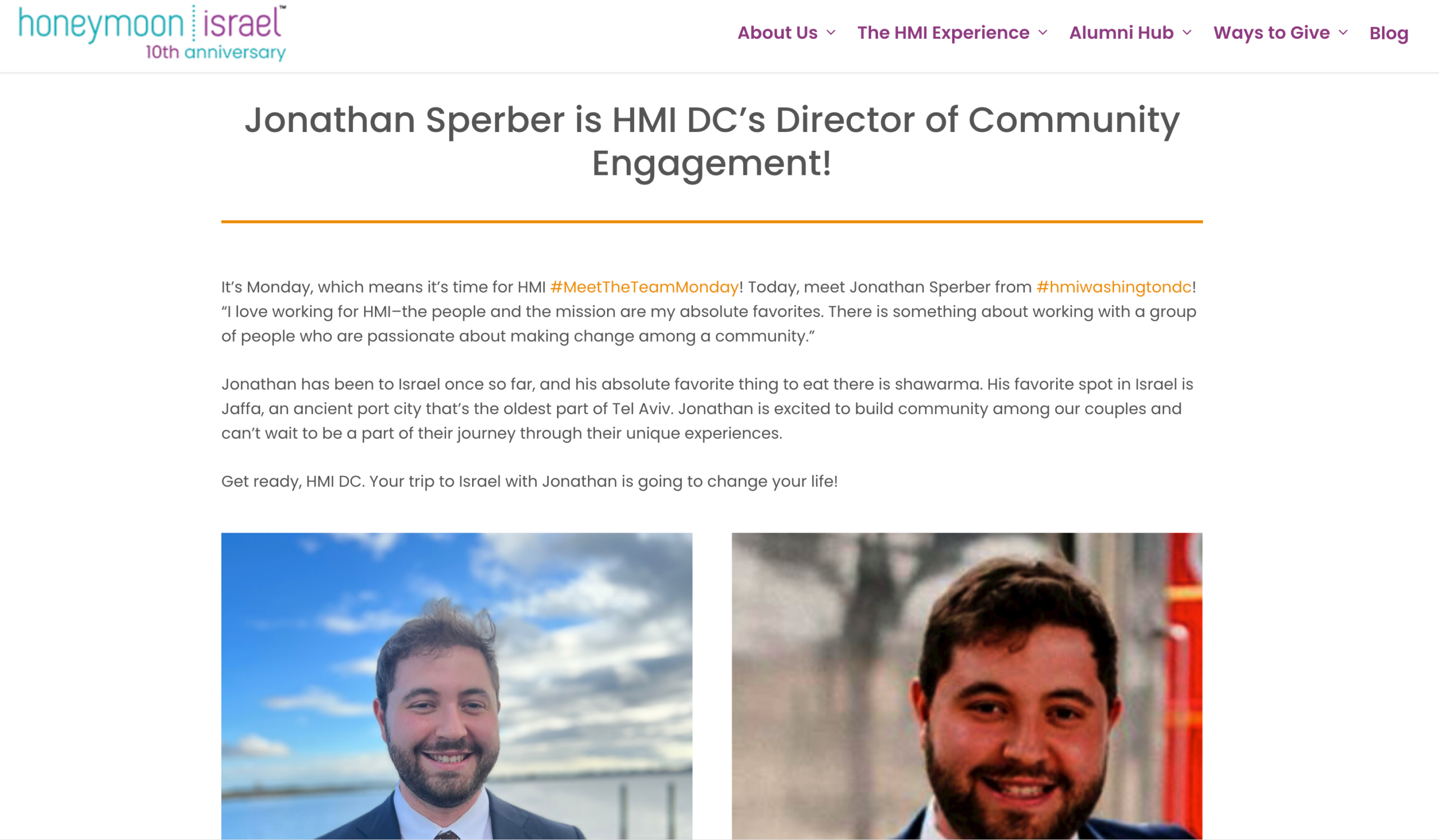
Honeymoon Israel’s stated mission is to provide immersive trips to areas within Occupied Palestine for couples that have at least one Jewish partner.
I cannot speak to his current beliefs, but I want to reaffirm The Convergence Lens’ and my own commitments to the principles of “al-Thawabit,” which include “the Palestinian people’s right to resistance, the Palestinian right to self-determination, the recognition of Jerusalem as the capital of Palestine, and the right of Palestinian refugees to return to their homeland from the river to the sea,” as well as the BDS movement. Someone with direct ties to apartheid Israel co-founding a tech company designed to predict and silence dissent is alarming, to say the least.
3. Chief of Staff: Dr. Sarah Taylor
Education: Ph.D. in Biology from UNC Chapel Hill. Dissertation on vascular endothelial growth factors in developing blood vessels.
Background: Taylor is one of two people on GUDEA’s team with a doctoral degree, which gives the company a thin veneer of academic credibility, but her PhD is in biology. She has exactly zero training in social networks, computational methods, bot detection, or anything remotely relevant to GUDEA’s claimed expertise.
After completing her doctorate, Taylor pivoted to business operations in the academic publishing services industry. She spent a decade climbing the corporate ladder at American Journal Experts, eventually becoming GM of a 200-person team. She then moved to VP of AI Products at Springer Nature Group, where she led the development of AI-powered writing assistants for scientists.
Taylor does not bring any qualification to study social media manipulation. A biologist who became a SaaS executive 15 years ago is not equipped to validate bot detection methodology or make authoritative claims about coordinated inauthentic behavior. Alongside that, her role as Chief of Staff seems to be operational, not necessarily leading any of this research methodology.
4. Product Manager: Dr. Ashley Smith
Education: Ph.D. in Pathobiology from Brown University. Dissertation on the integration of genetic and epigenetic alterations in the discovery of molecular drivers of malignancy in glioma – cancer biology.
Background: Like Taylor, Smith has a PhD in an unrelated biological science field. She also worked at American Journal Experts in various roles, eventually becoming an Operations Specialist. Researched toxicity of nanomaterials using in vitro based systems at Brown, but lacks expertise in non-laboratory research.
Her career has largely been in business operations and project management. Again, strong operational experience, zero relevant research credentials.
5. Client Experience Manager: Georgia Paul
Education: B.A. in Health/Healthcare Administration/Management, MBA in Business Administration from the University of North Dakota.
Background: After graduation, Paul worked various roles in program coordination and operations. She spent nearly two years at Techstars from October 2022 – August 2024 (note the connection to the investors of GUDEA), as a Program Manager running startup accelerator programs. Before that, she was Deal Sourcing Lead at Groove Capital (another one of GUDEA’s investors) for seven months.
Paul joined GUDEA in August 2024 and serves as their Client Experience Manager – a role focused on keeping clients happy and ensuring product adoption, not conducting research.
She was the one who originated the Taylor Swift study. In the Rolling Stone article, she’s quoted saying: “I’m a pop-culture girl,” claiming that she “had a gut feeling” that the ideologically charged remarks about The Life of a Showgirl being made might trace back to manipulative actors.
To reiterate: a customer success manager with a MBA in business administration and no research experience had a “gut feeling” about Taylor Swift discourse, and this became the impetus for a “study” that was laundered through dozens of media outlets as authoritative research.
6. Advisor: Heather Brocks Karatz
Education: B.A in Spanish and Philosophy from Vanderbilt University. J.D in Sports and Entertainment Law from the University of California.
Background: Owner, Angel City Football Club. Executive VP, Growth & Ops, United Talent Agency (UTA) – one of the top talent agencies in the world.
This is the smoking gun for the PR/entertainment alignment aspect to me. She is an advisor from the heart of the talent representation and celebrity investment world. Her involvement is a direct link from GUDEA to the PR ecosystem whose primary concern is protecting celebrity brand equity.
7. The Rest of the Team
Background: There are four other known employees. These are the team’s client experience managers, program managers, software engineers, etc. Their expertise is in customer success, venture capital deal sourcing, and program management.
They are the employees that service clients and run operations. They are also not researchers. This staff lineup is consistent with a B2B software/services company. It is not consistent with who you would see working at a research center.
The GUDEA team is built around a core group of political and entertainment industry strategy leaders, and supported by operational and product management staff. There is no evidence that I could find of a dedicated research team with PhDs in Network Science, Data Science, or Computational Social Science – the fields necessary to conduct the type of analysis GUDEA is claiming.
GUDEA has two people with PhDs: Taylor (biology) and Smith (pathobiology). This gives them a superficial impression of academic credentials. But having a doctorate in cell biology provides precisely zero relevant expertise for studying social media networks, bot detection, or coordinated online behavior.
Would you trust a veterinarian to perform your heart surgery? They’re both doctors, after all. This is the credential game GUDEA and many other companies play – the letters “PhD” lend false authority even when the actual expertise is completely unrelated.
Brocks Karatz, on the other hand, is a direct link between GUDEA and the very industry (talent representation/celebrity PR) that would hire a firm to defend Taylor Swift. This suggests that the report was either commissioned by that world or created explicitly for it.
In February 2025, GUDEA brought on a man named Zach Pentel as a marketing advisor. Pentel’s background includes senior marketing roles at Adobe, Apple, and Spotify. His LinkedIn describes GUDEA as “important tech to market” – not important research to validate, not critical findings to publish, but tech to market.
So, nine months before releasing their Swift study, GUDEA hired a heavyweight marketing strategist with Silicon Valley credentials. This further suggests that all of this is preparation for a major product launch disguised as research findings. Companies hire marketing advisors when they’re preparing to sell, not when they’re preparing to research.
But again, facts over assumptions here. Let’s look at the study itself to see if it aligns with this hypothesis.
Study Review: The Methodology That Wasn’t
Honestly, reading the full study was surprising to me, because it is so clearly presented as a white paper or analytical case study, not an academic paper.
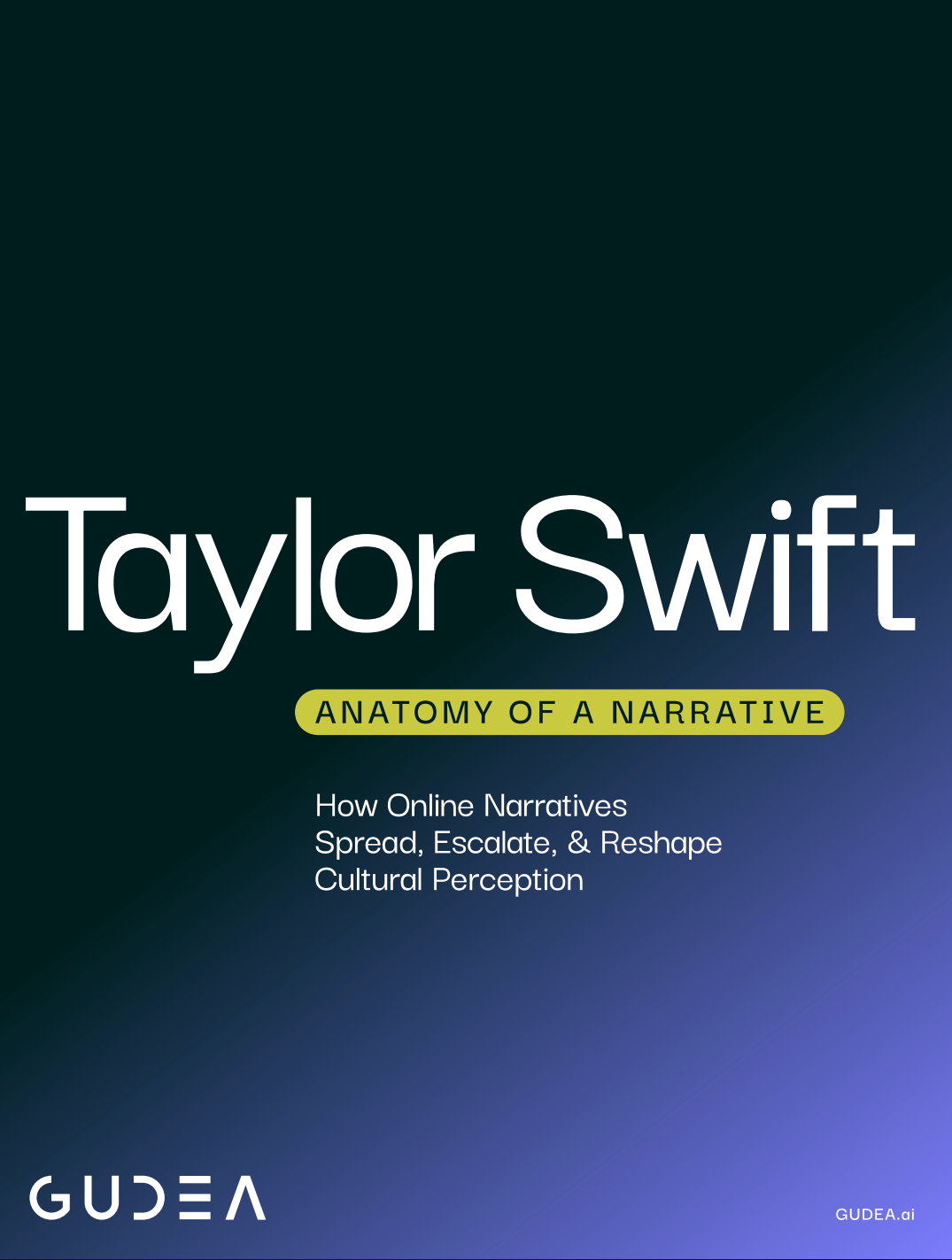
Its purpose is demonstrative (showcasing GUDEA’s platform) rather than purely investigatory, so the fact that several mainstream outlets reporting on this are treating it as if it is irrefutable science is concerning to me.
To Rolling Stone’s credit, they do correctly state that it is a white paper, but when calling GUDEA a “behavioral intelligence startup,” they also fail to mention that said startup markets to celebrity PR firms.
GUDEA’s objective is clearly stated: to analyze how online narratives about Taylor Swift “spread, escalate, & reshape cultural perception.” This is a valid research question for digital sociology, but as we’ve established, that’s not their realm of expertise.
What’s Being Claimed
The report analyzed 24,679 posts from 18,213 users across 14 platforms between October 4-18, 2025. Using their proprietary “Audience Behavior Classification” (ABC) system, GUDEA determined that while 96.23% of users behaved “typically,” the remaining 3.77% “drove 28% of the conversation volume” and created “inauthentic narratives” that “pulled typical users into comparisons between Swift and Kanye West.”
The conclusion was that Taylor Swift was targeted by a “coordinated attack” involving “outliers,” “facilitators,” “influencers,” and “power-players” who seeded false narratives about Nazi symbolism that then spread to normal users.
What GUDEA Doesn’t Disclose
To fully evaluate these claims, we would need answers to the following basic methodological questions:
Data Collection:
- How were the 14 platforms selected?
- What search terms or filters were used to identify relevant posts?
- How was the sample collected – random sampling, keyword search, algorithmic filtering?
- What proportion of total conversation does this sample represent?
- Were there selection biases in the collection method?
Classification System:
- How does the ABC system determine “typical” vs “non-typical” behavior?
- What specific metrics or signals does it use?
- How was the system validated against ground truth data?
- What are the false positive and false negative rates?
- How does it compare to established bot detection methods like Botometer?
Analysis Framework:
- How were “narratives” identified and clustered?
- How was “coordination” determined?
- What baseline comparisons were made to determine if patterns were unusual?
- How were organic discussions distinguished from inauthentic ones?
Reproducibility:
- Is the code available for independent verification?
- Can other researchers access the data (with appropriate privacy protections)?
- Has the methodology been published in peer-reviewed venues?
- Have independent researchers validated the findings?
GUDEA provides zero answers to any of these questions. Their methodology is a complete black box. They launched their ABC classification tool in November 2025 – just one month before releasing this study – meaning it was never independently validated before being applied to make sweeping claims about coordinated manipulation.
The 90-9-1 Problem
The study’s central finding – that 3.77% of users drove 28% of conversation volume – is presented as evidence of suspicious coordination. But this distribution is actually completely normal for social media discourse.
Internet researchers have documented the “90-9-1 rule” (also called the 1% rule) for decades: in most online communities, 90% of users lurk without posting, 9% contribute occasionally, and 1% create most of the content. Small percentages of highly engaged users naturally dominate conversation volume. This distribution has changed over time, and 90-9-1 is likely outdated, but the central idea of small percentages of users creating most content has not completely changed – certainly not enough to be immediate cause for concern in a situation like this.
Without baseline comparisons to other celebrity album releases, other controversial moments, or updated social media participation patterns, we have no way to know if the distribution GUDEA found is unusual or perfectly ordinary. But they present these distributions as clear evidence of a nefarious campaign.
The Blake Lively “Overlap”: Commentary Reframed as Conspiracy
The report identifies 2,395 accounts that appeared in both their Taylor Swift dataset and a separate dataset about Blake Lively, framing this overlap as evidence of a “cross-event amplification network” and suggesting “a concentrated group of repeat actors” was driving both narratives.
But – hear me out – what if we consider the obvious alternative explanation: both Swift and Lively are major celebrities who both had controversial moments during the same time period. Pop culture commentators, entertainment journalists, and engaged fans naturally discuss multiple celebrities. Finding overlap between these populations is like finding that baseball fans discuss multiple teams – it’s normal behavior.
The report even admits this: “The overlap is overwhelmingly Typical, indicating that normal users engaged with both narratives.” If the overlap consists primarily of their identified “typical” users, why frame it as an “amplification network”? This feels like narrative manipulation by GUDEA here – taking ordinary patterns and painting them out to be proof of widespread coordination.
The Nazi Narrative: Assuming Bad Faith Instead of Analyzing The Discourse
The report states: “The false narrative that Taylor Swift was using Nazi symbolism did not remain confined to fringe conspiratorial spaces; it successfully pulled typical users into comparisons between Swift and Kanye West.”
This framing presumes off the bat that the narrative was false and inauthentic rather than considering that:
- Some critics might have had genuine (if debatable) concerns about lyrical or aesthetic choices.
- Cultural criticism of powerful celebrities can be legitimate and vital discourse.
- The comparison to Kanye West might have organic roots in Swift’s extensively documented history with him.
- Online arguments about celebrity culture are normal internet behavior.
By assuming bad faith from the start, GUDEA never actually analyzes whether the criticism had any organic origins. Instead, they define all negative conversation as “attack narratives” that must have been artificially seeded. This is circular reasoning painting discourse as inauthentic simply because it’s critical.
What Legitimate Bot Research Looks Like
Academic researchers studying coordinated inauthentic behavior follow these established standards:
- Combine behavioral analysis, network analysis, content analysis, and temporal analysis for validation.
- Report false positive and false negative rates, precision, recall, F1 scores.
- Test classification systems against known ground truth datasets.
- Show what “normal” looks like using baseline comparisons to prove detected patterns are actually unusual.
- Submit findings to academic journals for expert scrutiny before public release.
- Share code and data (with appropriate privacy protections) so others can verify.
- Use probabilistic language and acknowledge limitations rather than making definitive claims.
- Disclose funding sources and commercial relationships.
GUDEA does none of these things. They do, however:
- Use proprietary black-box algorithms with no disclosed validation.
- Make definitive claims without error rates or uncertainty ranges.
- Fail to subject their methods to peer review.
- Provide no baseline comparisons to demonstrate unusual patterns.
- Allow no independent verification or replication.
- Disclose no funding sources or commercial motivations.
- Frame all findings as certain rather than probabilistic.
This methodology would surely be rejected by any academic journal, and it would not pass muster at a legitimate research conference.
The Media Rollout: The PR Laundering Machine
On December 9, 2025, Rolling Stone published their exclusive, titling it: “Taylor Swift’s Last Album Sparked Bizarre Accusations of Nazism. It Was a Coordinated Attack.”
The article featured exclusive quotes from GUDEA CEO Keith Presley, who called the pattern they found “a type of espionage.”
It presented GUDEA’s findings as authoritative, objective research. Rolling Stone described the company as providing “narrative intelligence” without explaining what that meant or examining the business model behind it. The article quoted Georgia Paul’s “gut feeling” origin story without questioning whether client experience managers should be initiating research studies and accepted Presley’s framing of this being a “coordinated attack” without seeking independent verification from academic experts.
Rounding it all up, Rolling Stone failed to disclose:
- That GUDEA is a venture-backed commercial startup selling crisis PR tools.
- That GUDEA’s investors expect financial returns that depend on finding “attacks” everywhere.
- That Presley’s background is in political strategy, not research.
- That GUDEA has employees who came from Techstars and Groove Capital, who are investors in the company.
- That the methodology had never been peer-reviewed or independently validated.
- That the ABC classification tool was launched just one month before this study.
Without this context, readers have no way to properly evaluate whether GUDEA’s claims are credible or not.
The Amplification Machine
Within 48 hours, a wave of reputable outlets repackaged the story:
- People: “Taylor Swift Album Criticism – Including Nazi Claims – Was ‘Narrative Manipulation’ by Bot-Like Accounts, Research Says”
- The Independent: “Taylor Swift hit by bot-fuelled Nazi conspiracy campaign, study finds”
- The Guardian: “Coordinated online attack sought to suggest Taylor Swift promoted Nazi ideas, research finds”
- And dozens more.
Almost none of these outlets disclosed any of the issues discussed earlier.
Instead, the media is treating GUDEA’s press release as fact. One outlet after another simply republished the findings, added quotes from the original Rolling Stone piece, and moved on. Each new article cited previous articles, creating a citation chain that gave the illusion of independent verification when in reality everyone is citing the same single source: GUDEA’s unvalidated report.
Why Journalists Failed
I do not believe this was simply lazy reporting, and it tells us a lot about how mainstream media is operating in 2025.
Media outlets face relentless pressure to publish constantly. A story with a celebrity angle (Taylor Swift), a tech angle (AI, bots), a political angle (coordinated attacks), and ready-to-go stats is like a gift from heaven. It’s SEO-optimized, highly shareable, and requires minimal additional reporting.
I found no proof thus far of any financial or personal ties between Swift and GUDEA. I cannot say either way if this was funded or fueled at all by her or her team. But if it is not, it is likely GUDEA approached journalists offering “exclusive data” about a major celebrity. By framing themselves as researchers rather than vendors, they would bypass the skepticism journalists typically apply to commercial sources.
The report includes impressive-looking data, technical terminology, and quantitative findings. For journalists without training in computational methods or social media research, this gives them the illusion of expertise. If it looks like research and uses research language, it must be research, right?
Modern journalism increasingly relies on finding sources who will make the attention-grabbing statements, not necessarily the ones with the most accurate information. GUDEA provided those statements to journalists gift-wrapped with a bow: “This is espionage,” “coordinated attack,” “inauthentic narratives,” etc.
These quotes drive headlines and social shares, which is what editors want. Questioning the source’s credibility would mean losing the quotes and having to do actual investigative work.
Then, Rolling Stone’s initial publication gave other outlets permission to cover the story. If Rolling Stone – a legacy publication with investigative credibility – treated GUDEA as authoritative, other outlets could cite Rolling Stone rather than doing their own verification. The chain of amplification makes each subsequent article seem more credible because multiple outlets are reporting on it.
The Irony: A Report About Manipulation That Manipulates
GUDEA’s report warns about “narrative manipulation” and “coordinated inauthentic behavior” while seemingly engaging in exactly that: manipulating the narrative through strategically seeded, carefully coordinated messaging designed to shift public perception for commercial gain.
The media became participants in this laundering operation, willing or unwilling.
GUDEA’s client-ready analysis was put out on public record as objective fact, all without a single outlet asking the most basic investigative questions: Who are you? Where does your funding come from? Who benefits from these findings?
The Future of “Astro-PR”: Faking Grassroots Analysis
Traditional astroturfing fakes grassroots support. For example: a political campaign creates fake local citizens’ groups, a corporation manufactures fake consumer testimonials, a brand generates fake social media accounts to create the illusion of organic enthusiasm or opposition.
Astro-PR is the natural evolution of this: faking grassroots analysis. Instead of manufacturing fake support, you manufacture fake expertise. You create the appearance of independent, data-driven research that supports your client’s desired narrative.
Here’s the full plan, based on GUDEA’s playbook:
Step 1: Creating the Asset
Develop a “research report” that:
- Looks legitimate: professional PDF, citations, charts, technical language.
- Feels substantial: enough pages and data points to seem thorough.
- Sounds authoritative: uses academic-style framing and methodology language.
- Supports the desired narrative: findings align with the client’s/your target’s interests.
- Provides quotable conclusions: dramatic language that drives engagement.
GUDEA’s report checks every box here. It’s 9 pages with appendices, includes terminology like “Audience Behavior Classification” and “Message Mapping,” features data visualizations and user archetypes, and arrives at the exact conclusion that serves both Taylor Swift’s reputation and GUDEA’s business model: this negative discourse was coordinated and inauthentic.
Step 2: Placing the Story
Secure a “respectable” media exclusive by:
- Pitching as research rather than marketing expert.
- Framing the report as data-driven investigation.
- Offering exclusive first access.
- Providing ready-made quotes for usage.
- Leveraging the outlet’s hunger for content that combines celebrity, technology, and conspiracy angles.
Rolling Stone was the perfect target for GUDEA: a legacy music publication that publishes long-form journalism, giving the story both pop culture relevance and investigative patina. The exclusive aspect ensured Rolling Stone had an incentive to publish quickly without giving the study too much scrutiny – exclusives are valuable commodities that create competitive advantage, after all.
Step 3: Amplifying Without Scrutiny
Once the initial story publishes, the media ecosystem takes over:
- Other outlets pick up the story because a respected publication covered it.
- Each new article cites previous articles, creating citation chains.
- The story gains credibility through repetition.
- Search engines and social algorithms amplify based on engagement.
- The source’s potential biases get buried under layers of secondary coverage.
Within 48 hours, GUDEA’s unvalidated claims had been laundered through dozens of outlets. The initial lack of scrutiny from Rolling Stone gave everyone else permission to skip their own verification. If you’re the 20th outlet covering this story, you’re probably not taking the time to investigate GUDEA’s methodology, you’re rushing to add your outlet’s take on what multiple sources are reporting.
Step 4: Inverting the Narrative
The most insidious aspect of Astro-PR is the narrative inversion, the way they are shifting the conversation from the original allegation to a new meta-narrative about the allegation.
In this case:
- Original narrative: Some people criticized Taylor Swift’s album, questioning certain aesthetic or lyrical choices.
- GUDEA’s narrative: The criticism was a coordinated inauthentic attack.
- Meta-narrative: Anyone questioning GUDEA’s analysis is part of the attack.
Criticism of the study itself can now be dismissed as evidence of the very conspiracy the study claims to document, as this article itself may likely be. Skeptics like me become further proof of coordination. The narrative then becomes unfalsifiable: it’s real, look at all these outside forces trying to suppress it!
This inversion serves multiple purposes:
- Protects the client by delegitimizing criticism.
- Demonstrates the tool’s value by “catching” a major attack.
- Makes future criticism of the client riskier (am I, too, part of a bot network?)
- Media coverage serves as future evidence that the threat was real.
Step 5: Commercial Capture
The ultimate goal is commercial benefit:
- For GUDEA: The study becomes a case study for sales pitches, proof the tool works, validation for investors, and generates media attention worth millions in ad value.
- For potential clients: Other celebrities, brands, and political figures see that reputation threats can be “documented” and “proven,” driving demand for similar services.
- For investors: Traction metrics improve (media mentions, web traffic, demo requests), making the next funding round easier.
Rolling Stone’s article mentioned that the report was created “of [GUDEA’s] own initiative after team members noticed suspicious patterns of activity.” This framing is pretty smart: it suggests GUDEA is so good at their job that they detect attacks even without being hired, implying that anyone not using their services is vulnerable.
Why is Astro-PR So Dangerous?
Traditional astroturfing is relatively easy to identify once you know what to look for: check account creation dates, examine posting patterns, trace back to coordinating entities, etc. Astro-PR will be much harder to detect.
It looks like research, generates real coverage, creates citation chains, and survives initial scrutiny.
As this grows in popularity, the information environment will be further polluted with pseudo-research that looks indistinguishable from real research to non-experts. Media outlets lose the ability to quickly differentiate between peer-reviewed academic findings and marketing materials. The public’s trust in both journalism and research erodes because the lines between them have been intentionally blurred.
The Astro-PR Arms Race
If GUDEA’s approach succeeds – and by many measures it already has – we should expect proliferation:
- Political campaigns will commission “studies” showing that their opponents are targeting them with bots.
- Corporations will produce “research” proving criticism is coordinated by competitors.
- Celebrities will document “attacks” to delegitimize negative press.
- PR firms will build entire divisions around producing pseudo-academic analyses.
- Venture capital will flood into “narrative intelligence” startups.
- Media outlets will become even more dependent on this ready-made “research” content as they are forced to keep up with one another.
Each case makes the next easier because the standards erode incrementally. If Rolling Stone doesn’t verify GUDEA’s credentials, why should Variety verify the next company? If no outlet demanded peer review this time, why expect it next time? The competitive pressure to publish quickly beats out the professional obligation to verify information slowly.
Within a few years, we may reach a point where any significant online criticism of powerful entities is automatically framed as coordinated inauthentic behavior by a “narrative intelligence” firm, laundered through credulous media coverage, and accepted as evidence of manipulation even when it is organic discourse.
A Prototype for the Future of Story Spinning
This was unfortunately not an isolated incident of sloppy journalism or an unfortunate misunderstanding about research standards. It was a blueprint for how the tools of Silicon Valley, the incentives of entertainment economics, the tactics of political warfare, and the vulnerabilities of a depleted media landscape can fuse into a concerning new form of influence.
For GUDEA, their playbook has already succeeded:
- Massive media coverage worth millions in advertising value.
- Positioning as an authoritative voice on online manipulation.
- Perfect case study for sales pitches to celebrity managers, corporate communications teams, and political campaigns.
- Validation for their venture capital investors showing market demand and product-market fit.
- Establishment of “narrative intelligence” as a category requiring professional services.
For Taylor Swift (whether she commissioned this study, cooperated with it, or simply benefited from it), the outcome is ideal: criticism has been delegitimized, converted from potentially legitimate cultural commentary into evidence of conspiracy, all while maintaining plausible deniability about any involvement.
And for the media outlets that amplified this story without scrutiny, there are no consequences. They got their clicks, filled their content quotas, and provided their audiences with a satisfying narrative about powerful hidden forces attacking America’s pop princess. Whether the story was true…well, that matters less than whether it was engaging.
The Stakes Are Higher Than We Know
What makes this so alarming to me is the sheer size of its scalability. If venture-backed companies can manufacture the appearance of authoritative research, seed it through credulous media, and benefit from the resulting coverage without accountability, verification, or correction – then we are facing a looming crisis.
For journalism, this is the total collapse of sourcing diligence. When reporters can’t or won’t distinguish between peer-reviewed research and startup marketing materials, when “studies show” becomes equivalent to “someone paid money to produce a document that says,” journalism loses its core function as a verify-then-publish gatekeeper.
Research washing also devalues actual scholarship in academia. Why spend years learning to produce rigorously validated findings when a startup can generate the appearance of research in weeks and get more media attention?
And if all criticism can be dismissed as coordinated attacks documented by AI tools, dissent becomes impossible. The powerful gain the perfect shield: any negative attention gets reframed as evidence of conspiracy rather than accountability.
Political campaigns will weaponize this playbook to delegitimize opposition. Corporations will use it to silence whistleblowers and critics. Governments will deploy it to justify censorship. The information environment becomes so polluted with sophisticated pseudo-research that citizens lose the ability to distinguish real findings from propaganda.
What Must Change
There are several immediate necessary responses:
From journalists:
- When a “study” emerges, check who authored it, what their qualifications are, whether they’ve published peer-reviewed research.
- Identify funding sources, investor relationships, and commercial motivations.
- Before publishing claims about online behavior, consult actual academic experts in relevant fields.
- Demand transparency about data collection, classification systems, validation metrics, and baseline comparisons.
- Tell readers when sources have commercial incentives that align with their “findings.”
From platforms and media institutions:
- Create guidelines for covering statistical claims and research findings.
- Hire or consult with specialists who can evaluate computational methods.
- When outlets amplify bad research, they should correct the record ASAP, not let false claims persist.
From academia:
- Researchers must be more active in calling out pseudo-research and explaining why methodology matters.
- Academic peer review is too slow to counter instant media cycles, so researchers should have mechanisms for rapid assessment of claims.
From regulators:
- Consider requiring disclosures by law when commercial entities present work as “research” or “studies” without peer review.
- Using “studies show” to market products may constitute false advertising if the studies don’t meet basic standards.
A Lesson for Us All
When you encounter a headline declaring “Study finds…” or “Research shows…” or “Data reveals…”, your first questions should always be:
Where is the data coming from, who paid for it, and who benefits from its conclusion?
Look for:
- Funding sources: Is this from a university, government agency, or commercial entity?
- Author credentials: Do they have relevant PhDs and published work in the field?
- Peer review: Has this been validated by independent experts?
- Methodological transparency: Can you see how they reached their conclusions clearly?
- Conflicts of interest: Do the findings align suspiciously with business incentives?
This GUDEA dossier is a prototype, and prototypes get refined. The next iteration will be more sophisticated, harder to detect, and better at mimicking legitimate research. The ventures will learn from this case what worked and what created vulnerability.
Future Astro-PR operations could include:
- Partnering with academic institutions for further credibility.
- Recruiting a few research-qualified team members as window dressing.
- Publishing selective methodology details while keeping core algorithms proprietary.
- Citing legitimate research alongside their own to create false equivalence.
- Using “independent” third parties to validate findings.
- Timing releases strategically around regulatory or cultural pressure points.
These companies are venture-backed, well-funded, and staffed by people skilled in strategic communications and narrative control. They are learning from each deployment what works and what doesn’t.
Journalism, academia, and civil society must respond quickly, build antibodies to this infection before it becomes systemic, and preserve the possibility of determining truth in a world where well-funded entities can manufacture the appearance of said truth at a scale previously unseen.
The GUDEA report is not completely unrealistic; there are valid questions asked within it. Bots undoubtably did contribute to the amplification of this discourse, as they contribute to quite literally every topic on the internet. We may never get an accurate read on the percentages of bot accounts that exist online compared to real users. Perhaps this discourse was artificially sown – I do not believe so, but it’s plausible.
Regardless, the fact that journalistic integrity failed on multiple levels and that PR companies are evolving to embrace the ever-growing AI lovefest, to me, is the real story here. I do not believe we should allow this type of narrative manipulation go unchecked. Don’t you agree?
Disclaimer:
This article exercises the journalistic and public right to critique methodologies, question biases, and analyze the media ecosystem, including the actions of companies, public figures, and news organizations. The conclusions drawn are my interpretations and analysis, based on publicly available information. All claims are based on documents and data cited within the article. We have made a good-faith effort to accurately represent these sources. This analysis does not accuse any individual or entity of illegal activity. It is being published in the interest of fostering informed public debate on the integrity of information in the digital age. GUDEA, Taylor Swift’s representatives, and the media outlets named are invited to provide comment or clarification for inclusion in this article or future coverage by emailing [email protected].